

Chances are, you’ve already met a service robot and didn’t think twice about it. Maybe it was the little vacuum quietly working its way around your living room while you were at work.
Maybe it was the delivery bot rolling down a hotel hallway with a room service order, beeping softly at the elevator. These machines have slipped into everyday life so smoothly that most people don’t even register them as robots anymore; they just seem like appliances with a bit of personality.
That’s actually the whole point. Service robots are designed to blend in, not stand out. Unlike the robotic arms welding car frames on a factory line, service robots work in the messy, unpredictable spaces humans actually live and work in: hotels, hospitals, warehouses, sidewalks, living rooms.
So what exactly counts as a service robot, and where’s the line between “robot” and “smart gadget”? Turns out there’s an actual industry definition for that, and it’s more specific than you’d think.
This guide breaks down what service robots really are, the different types you’ll run into, how they work under the hood, and where they’re already doing real work right now, not someday.
What Are Service Robots?
Here’s the official version, straight from the International Federation of Robotics: a service robot is a machine that performs useful tasks for humans or equipment, has some degree of autonomy, and this is the key part, If you’re still fuzzy on the bigger picture, it helps to back up a step and look at what is robotics as a whole before narrowing into a specific category like this one.
That last bit is what separates it from the robotic arm bolted to a car factory floor. The ISO 8373 standard puts it a bit more formally, but says essentially the same thing: a service robot works in personal or professional settings, doing tasks that benefit people directly, rather than assembling products on a line.
Compared to industrial robots, service robots tend to be mobile rather than fixed in place. They wander hallways, roll through warehouses, and navigate rooms full of unpredictable humans and furniture a very different challenge than repeating the same welding motion a thousand times a day in a controlled cage.
That mobility, and the messiness of the environments they work in, is honestly what makes them so much harder to build well.
How Service Robots Work
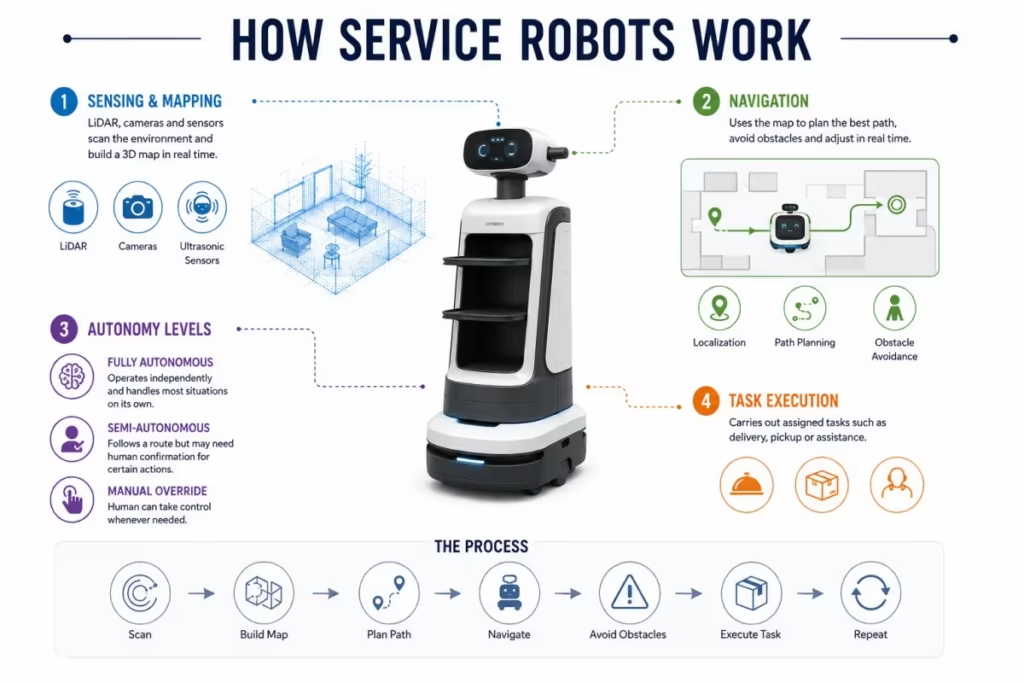
Building a robot that can safely wander through a hotel lobby or a hospital corridor is a genuinely different engineering problem than building one that stays bolted to a factory floor. Here’s what’s actually going on under the hood.
Sensing and mapping is where it starts. Most service robots use LiDAR, a laser-based sensor that builds a 3D map of the space in real time, combined with cameras and sometimes ultrasonic sensors to spot obstacles a laser might miss, like glass doors or a stray chair leg.
Navigation relies on that map to plan a path and adjust it on the fly. This is the same underlying technology behind autonomous mobile robots, or AMRs machines that move through a space independently rather than following a fixed track.
A warehouse AMR and a hotel delivery robot aren’t all that different under the surface; they’re both solving the same basic problem. It’s worth noting this is a very different problem than the one facing marine and underwater robotics, where radio signals don’t travel at all, and robots have to lean on sonar instead of lasers to find their way.
Autonomy levels vary quite a bit, though. Some service robots run almost entirely on their own, only needing a human to step in for edge cases. Others are what’s called semi-autonomous; they’ll follow a route independently but wait for a person to confirm before doing something like opening a door or approaching a stranger.
And then there’s the human override, which matters more than people realize. Even the most independent service robots usually have a manual control option built in, because these are the same fundamental building blocks anyone runs into when they start figuring out how to build a robot, just tuned for people-filled spaces instead of controlled ones.
Types of Service Robots
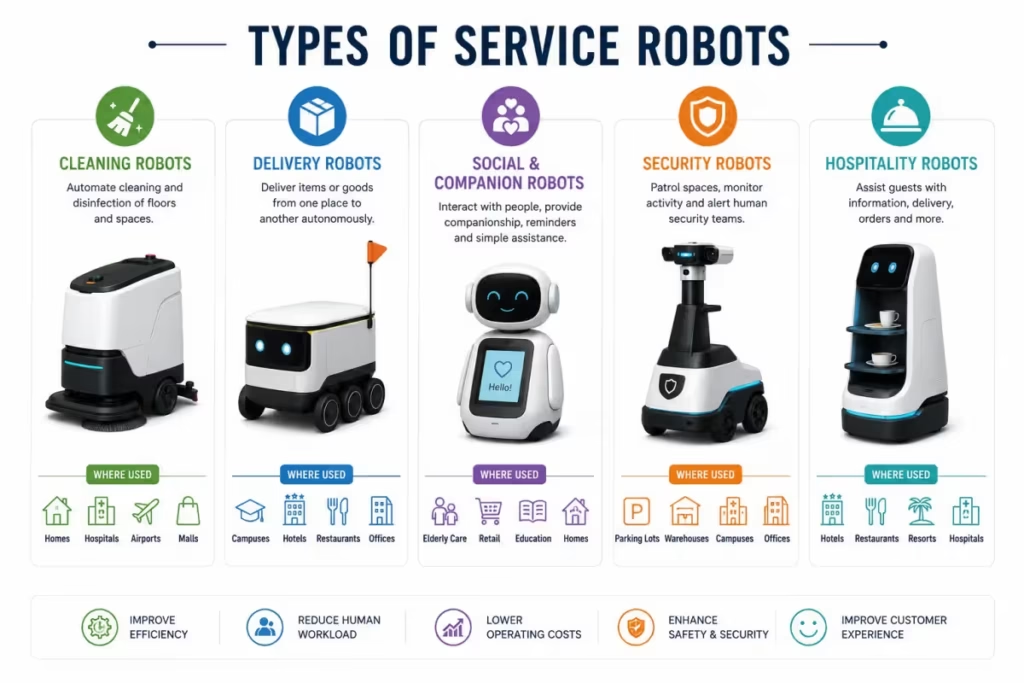
Service robots come in a lot of different shapes, and honestly, that variety is the whole appeal. A robot built to vacuum a living room. It’s a similar story to the different types of robots in agriculture, where the job a robot is built for shapes nearly every design decision that follows. Let’s go through the main categories.
Cleaning Robots
This is probably the type most people have actual hands-on experience with. Robotic vacuums are the obvious consumer example, quietly mapping a living room and dodging furniture on their own.
But cleaning robots go well beyond the home; commercial versions scrub floors in airports, malls, and hospitals, often running overnight shifts when the building’s empty.
Some hospital-grade cleaning robots even use UV light instead of chemicals to disinfect a room after a patient is discharged, which is a pretty clever solve for a problem that used to eat up a lot of staff time.
Delivery Robots
You’ve probably seen these without realizing what they were: small, boxy robots rolling along sidewalks near college campuses, or sleeker versions gliding down hotel corridors with room service.
Delivery robots handle the “last hundred feet” problem: getting an item from a central point to a specific person without needing a human to make that final trip. Restaurants use them to run food from kitchen to table; hotels use them for everything from towels to late-night snacks.
Social & Companion Robots
This category leans more emotional than functional. Social robots are built to interact with people through voice, facial expressions, or simple gestures rather than to complete a physical task. Some are aimed at elderly care, offering companionship or medication reminders.
Others show up in retail, greeting customers or answering basic questions. It’s a strange, genuinely interesting corner of robotics, because the “job” here isn’t lifting or cleaning; it’s making a person feel a little less alone, or a little more helped.
Security Robots
Security robots patrol spaces such as parking lots, warehouses, and office campuses, typically equipped with cameras and sensors that flag any unusual activity for a human security team to review.
They’re not typically armed or confrontational; think of them more as a very persistent set of eyes that never gets tired on a night shift, rather than a robot cop.
Hospitality Robots
Hotels and restaurants have become among the fastest-growing sectors for service robots. Beyond delivery, hospitality robots handle concierge-style tasks, answering guest questions, guiding people to their rooms, even taking food orders.
It’s a natural fit: hospitality is full of repetitive, predictable interactions that a robot can handle just fine, freeing up staff for the moments that genuinely need a human touch.
Personal vs. Professional Service Robots
If there’s one distinction that trips people up, it’s this one, and it’s actually the exact split the International Federation of Robotics uses to categorize the entire industry. The line isn’t about how smart a robot is. It’s about who’s using it.
| Personal Service Robots | Professional Service Robots | |
|---|---|---|
| Who operates it | Everyday users, no training needed | Trained professional operators |
| Setup | Plug-and-play, consumer-friendly | Often requires installation/configuration |
| Typical settings | Homes | Hospitals, hotels, warehouses, offices |
| Examples | Robot vacuums, lawn mowers, smart companions | Delivery robots, cleaning robots, AMRs, surgical assistants |
| Cost | Generally low, consumer-priced | Higher, often leased or contracted |
| Autonomy expectations | Simple, single-task focus | Complex, multi-environment navigation |
The honest way to think about it: personal service robots are built for accessibility, professional ones are built for capability. A robot vacuum doesn’t need to understand hospital hallway etiquette.
A hospital cleaning robot absolutely does. Neither is “more advanced” across the board; they’re just solving completely different problems, which is why the two categories rarely overlap in design.
Real-World Applications of Service Robots
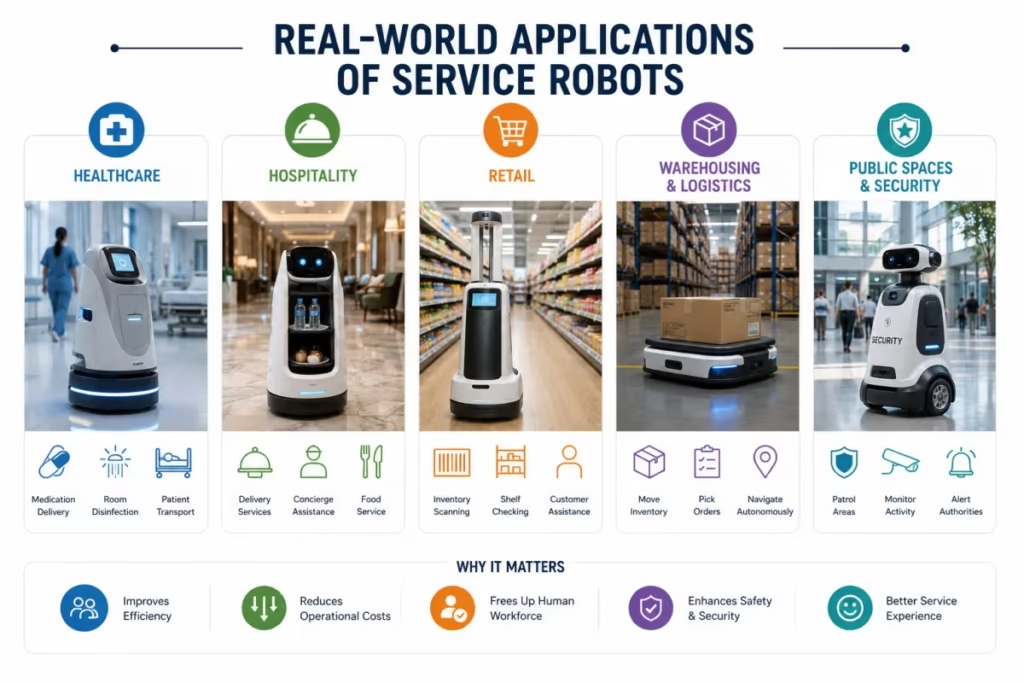
Healthcare is one of the biggest adopters. Hospitals use service robots for medication delivery, room disinfection, and even patient transport, freeing up nursing staff for the parts of the job that genuinely need a human touch.
It’s a similar sensor-driven, close-monitoring philosophy to how robotics shows up elsewhere in healthcare settings.
Hospitality has embraced service robots faster than almost any other sector; hotel delivery bots, restaurant servers, and lobby concierge robots have become common enough that guests barely blink anymore.
Retail uses service robots for inventory scanning, shelf-checking, and customer assistance, quietly working overnight shifts to flag out-of-stock items before a manager even walks in the next morning.
Warehousing and logistics is arguably the largest professional service robot category by sheer numbers. Autonomous mobile robots move inventory, pick orders, and navigate crowded warehouse floors, the same underlying autonomous-navigation approach used by mobile robots working fields in agriculture.
It’s not far off from precision agricultural robotics and autonomous farming, where that same sensor-driven precision gets pointed at crops instead of inventory.
Public spaces and security round things out, with robots patrolling parking structures, campuses, and office buildings, acting as an extra set of eyes rather than a replacement for human security staff.
Challenges in Service Robotics
Unstructured environments are the core engineering challenge. A factory floor is predictable; a hotel lobby is not. People walk unpredictable paths, furniture gets rearranged, kids run in front of things. Building a robot that handles that chaos reliably, day after day, is a genuinely harder problem than most people assume
Trust and human-robot interaction matter more than the hardware itself, in a lot of cases. A delivery robot can navigate perfectly and still get avoided by guests who simply feel uneasy around it.
Companies spend real time and money designing robot behavior how they signal intent, how they move around people- specifically to make them feel less alien and more predictable.
The cost of adoption is still a barrier for a lot of businesses, especially smaller ones. Professional service robots aren’t cheap, and the return on investment depends heavily on the specific use case and how much labor time they actually free up.
Workforce concerns are worth acknowledging honestly rather than glossing over. Automation naturally raises questions about job displacement, particularly in roles built around repetitive tasks.
Most current data suggests that in the near term, service robots are handling supplemental tasks the workload nobody wants rather than fully replacing staff, but it’s a legitimate concern in the broader conversation, not a footnote to dismiss.
The Future of Service Robots
A few clear trends are shaping where this field goes next.
AI-driven personalization is probably the biggest shift already underway. Instead of running the same fixed routine every time, service robots are getting better at adjusting behavior based on context, recognizing a returning hotel guest, or rerouting around a busy hallway instead of just waiting it out.
Humanoid service robots are getting a lot of attention lately, and for good reason: a robot shaped roughly like a person can, in theory, work in spaces designed for people without needing custom infrastructure.
Whether that pans out at scale is still an open question, but it’s That same shift toward context-aware autonomy is already showing up elsewhere in robotics too, including in ocean-monitoring robots quietly tracking climate data without a person anywhere nearby.
Labor shortages are quietly accelerating adoption across hospitality, healthcare, and warehousing sectors that have struggled to fill repetitive, physically demanding roles. Service robots aren’t stepping in to replace people so much as filling gaps that were already sitting empty.
Put it all together, and it’s fair to say service robots are past the novelty phase. They’re not a future technology anymore; they’re a present one that’s still figuring out how far it can go.
Wrapping Up
Service robots have quietly become part of the background of everyday life in hotels, hospitals, warehouses, and yes, plenty of living rooms. Whether it’s a cleaning robot working the night shift, a delivery bot navigating a crowded sidewalk, or a companion robot keeping someone company, these machines are handling the tasks that are repetitive, exhausting, or simply better suited to something that never gets tired. And given how fast adoption is accelerating across nearly every industry, this is one corner of robotics that’s only going to become more familiar, not less.
1. What’s the difference between a service robot and an industrial robot?
Industrial robots work in fixed, controlled environments like factory floors, usually repeating the same task over and over, think welding or assembly. Service robots do the opposite: they’re mobile, work in unpredictable spaces full of people, and handle a much wider range of tasks, from vacuuming a living room to delivering room service in a hotel.
2. Are robot vacuums considered service robots?
Yes, a robot vacuum is technically classified as a personal service robot under the industry’s own definition. It’s autonomous, performs a useful task for a person, and doesn’t require any special training to use, which is exactly what puts it in the “personal” category alongside things like robotic lawn mowers.
3. What’s the difference between personal and professional service robots?
It comes down to who’s using them. Personal service robots are built for everyday people with no training required think robot vacuums or companion devices. Professional service robots are designed for trained operators in commercial settings, like hospital cleaning robots or warehouse AMRs, and usually involve more setup and higher cost.
4. Are service robots replacing human jobs?
Not really, at least not yet. Most current data points to service robots filling labor gaps in roles that are hard to staff, repetitive tasks, night shifts, and physically demanding chores rather than replacing people outright. It’s a legitimate concern worth watching, but the near-term trend leans more toward supplementing short-staffed teams than eliminating positions.
5. How do service robots navigate without getting lost?
They rely mainly on LiDAR sensors, which use lasers to build a real-time 3D map of their surroundings, combined with cameras to catch things a laser might miss, like glass doors. That map lets the robot plan a route and adjust it on the fly if something or someone gets in the way.
7. What industries use service robots the most?
Healthcare, hospitality, retail, and warehousing/logistics are the biggest adopters right now. Warehousing in particular accounts for the largest share of professional service robots in use globally, mostly in the form of autonomous mobile robots moving inventory around.