
Ask most people to name a farm robot, and they’ll probably say “drone.” Maybe a self-driving tractor if they’ve seen a John Deere commercial. Beyond that? It gets fuzzy fast.
That’s a bit surprising when you look at the numbers. The global agricultural robots market sits at $17.73 billion in 2025, according to MarketsandMarkets, and is projected to reach $56.26 billion by 2030. That’s not a niche industry quietly experimenting in lab conditions. That’s serious capital chasing serious problems: labor shortages, rising input costs, climate unpredictability, and the relentless pressure to produce more food with fewer resources.
Here’s the thing, though. “Agricultural robots” isn’t one thing. It’s a whole ecosystem of machines, each designed for a specific job and operating in very different ways. A robot that picks strawberries has almost nothing in common with one that maps crop health from the air. A milking robot in a dairy barn uses completely different technology from a laser weeder moving through lettuce rows at dawn.
So what is robotics in the context of farming? Simply put, it’s the application of automated machines that can perceive their environment, make decisions, and carry out physical tasks with minimal or no human input. In agriculture, that definition now covers everything from a compact electric weed puller to a fleet of solar-powered seeders working through the night.
This guide maps the full picture. Every major type of robot currently working on real farms, what each one actually does, which companies are building them, and, importantly, how they connect to the broader shift toward precision agriculture that’s reshaping food production globally.
What Is Robotics in Farming? The 3 Categories of Agricultural Robots
Before getting into individual machines, it helps to have a mental map. Because once you understand the three broad categories farm robots fall into, the rest of the picture clicks into place quickly.
Every agricultural robot working on farms today fits into one of these:
| Category | How it moves | Primary environment | What it does |
|---|---|---|---|
| Ground robots (UGVs) | Wheels, tracks, or legs | Crop rows, fields, barns | Weeding, seeding, harvesting, milking, scouting |
| Aerial robots (UAVs) | Flight | Above fields and crops | Monitoring, mapping, and spraying |
| Specialist livestock robots | Fixed or guided | Barns, dairy facilities, greenhouses | Milking, feeding, transplanting |
That’s the whole map. Everything else is a variation within one of those three.
Ground robots are the largest and fastest-growing category of machines that navigate through field environments at the crop level. Aerial robots, mostly drones, work from above and cover ground faster than any wheeled system can. Specialist robots handle controlled environments, such as dairy barns, greenhouses, and automated feeding stations, where precision matters but the setting is more predictable.
Now, all three categories exist for the same underlying reason. The proportion of the global workforce employed in agriculture has dropped from 40% in 2000 to just 26% in 2022, according to FAO’s 2024 Statistical Yearbook. Fewer people are available to do physically demanding, time-sensitive farm work. Robots don’t replace the farmer; they fill the gap left by shrinking labor pools.
And the types of robots in agriculture aren’t competing with each other. On a well-run modern farm, all three categories work together. A drone maps crop health from above. A ground robot acts on that data at the field level. A livestock robot handles the barn operations independently. Each handles the layer of farming it’s best suited for.
Ground Robots: What They Do and Who Makes Them
Ground robots are where most of the action is in agricultural robotics right now. They move through fields at crop level, handle the tasks that are physically demanding or precision-heavy, and increasingly do it with no one watching. Four distinct robot types live in this category, and each one is solving a different problem.
Weeding Robots: Mechanical Precision, No Chemicals
Weeding is one of farming’s most labour-intensive tasks. It’s also one of the most chemically intensive. Conventional herbicide application treats entire fields uniformly, which means healthy soil, beneficial insects, and surrounding ecosystems all absorb chemicals that were really only needed in specific patches.
Weeding robots change that equation entirely.
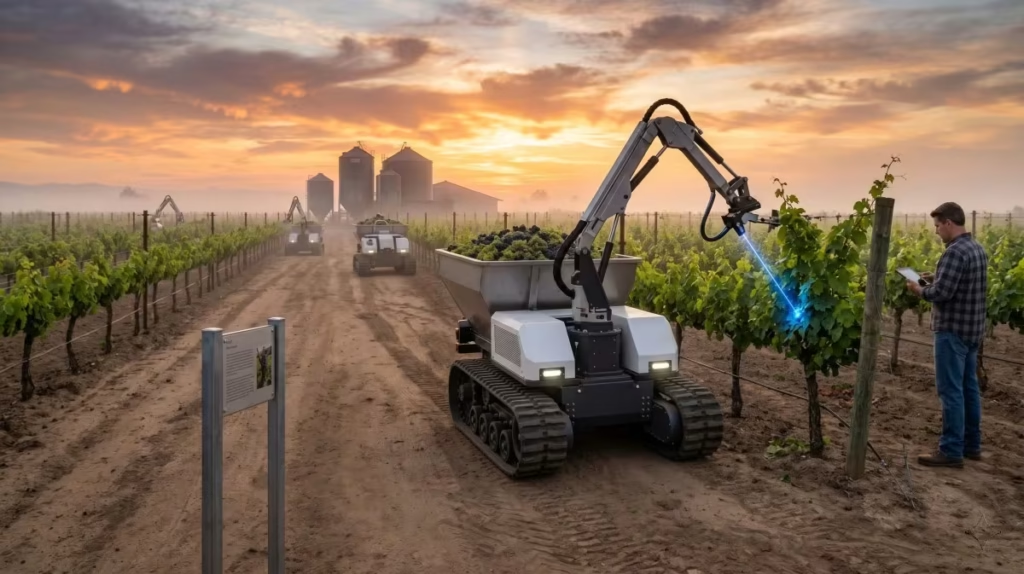
Carbon Robotics’ LaserWeeder is probably the most striking example in this space right now. It uses computer vision and deep learning to identify individual weeds among crops, then eliminates them with high-powered lasers, no contact, no chemicals, no soil disturbance. The system processes up to 100,000 weeds per hour. That’s not a typo.
Naïo Technologies takes a different but equally effective approach. Their OZ robot for vegetable crops and TED robot for vineyards use mechanical tools, blades, and tine harrows to physically remove weeds between and within rows. Both are fully electric, lightweight enough to avoid soil compaction, and operate autonomously with no on-site supervision required. Naïo reports its fleet has collectively prevented nearly 2,000 tonnes of CO₂ emissions across all deployments, a figure that reflects both reduced fuel use and reduced herbicide production.
Machine learning in agriculture is what makes all of this possible. A weeding robot that can’t reliably distinguish a crop seedling from a weed at scale is just an expensive way to destroy a harvest. The models running on these machines have been trained on millions of plant images across dozens of crop types. That training depth is what makes them commercially deployable rather than just academically interesting.
Seeding and Planting Robots – Precision From Day One
Here’s something most people don’t think about: the position of every seed in a field determines everything that comes after it. Spacing, depth, and pattern get those wrong, and weeding robots can’t work intra-row, irrigation systems can’t target precisely, and yield consistency suffers.
FarmDroid’s FD20 uses RTK GPS to place each seed with 8mm accuracy. Because it records the exact location of every seed at planting, it can return to weed between individual plants without cameras or vision systems, because it already has the map. The machine is solar-powered and runs up to 24 hours a day. On some operations, farmers report yield increases of up to 40% simply from the consistency that precision seeding enables downstream.
Fendt’s Xaver takes a different approach to swarm seeding. Rather than one robot doing everything, a fleet of small Xaver units divides the field between them, seeds cooperatively, and completes the job faster with far less soil compaction than a heavy single machine. Each robot is battery-electric, communicates with a cloud-based control system, and can be monitored from a tablet at any location.
For a deeper look at how these robots navigate autonomously, the GPS systems, the path planning, and the real-time obstacle avoidance that make precision seeding possible at scale, our guide on autonomous mobile robots in agriculture covers that layer in full detail.
Harvesting Robots: The Hardest Problem in Farm Automation
Harvesting is where agricultural robotics faces its toughest engineering challenge. And honestly, it’s worth understanding why before looking at the solutions.
Crops aren’t uniform. A strawberry field doesn’t present neat, identical objects in predictable positions. Fruit hides behind leaves. Ripeness varies plant by plant, sometimes cluster by cluster. The gap between a ripe berry and an unripe one is a matter of colour gradients that shift in different lighting conditions. And picking requires a grip that’s firm enough to detach the fruit but gentle enough not to bruise it.
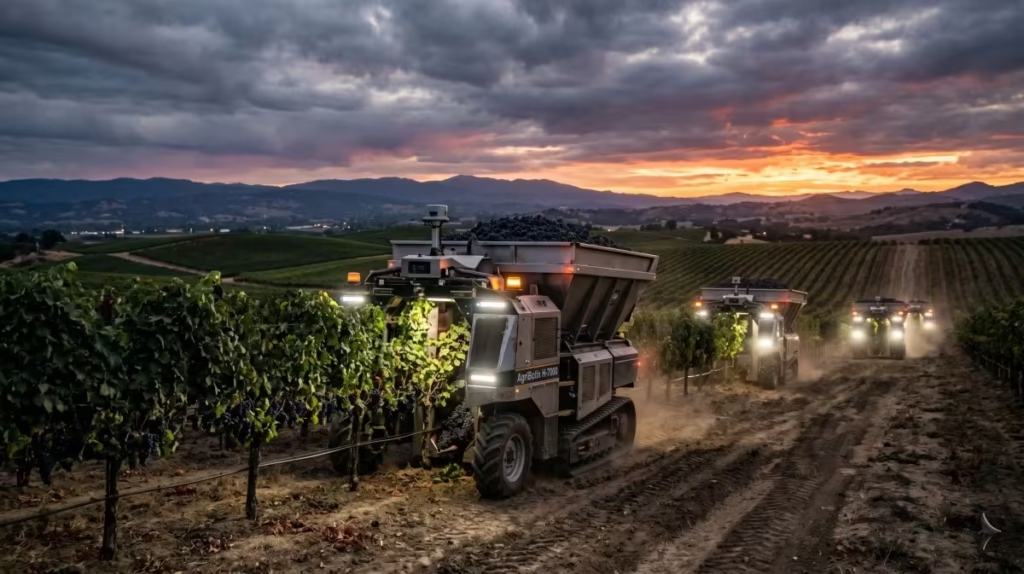
Agrobot’s strawberry harvesting system uses a bank of robotic arms, each with its own vision system, to assess ripeness and pick individually. Each arm operates independently, so if one fruit is unripe, that arm passes and the next one moves in. The system has been deployed commercially in Spain and the United States.
Tortuga AgTech focuses on berry crops in greenhouses and high tunnels, a more controlled environment that makes vision and manipulation easier. FFRobotics is tackling tree fruit, apples, citrus, and stone fruit using multi-arm systems that can pick at commercial speed. A 2025 MDPI systematic review of 59 field robots found that harvesting systems now achieve weed removal accuracy as high as 92.6% in targeted applications and crop damage rates as low as 1.2% in the most advanced strawberry-picking deployments.
Is robotic harvesting fully solved? Not yet. For most high-value fruit crops, it’s still faster than hand-picking in some conditions and slower in others. But the performance gap is closing season by season, and in regions where seasonal harvest labour is structurally unavailable, even partial automation changes the economics significantly.
Autonomous Tractors – The Farm’s Heavy Lifter, Now Driverless
Autonomous tractors handle the heavy work, plowing, tilling, broad-acre spraying, and large-scale planting using the same kind of AI-driven navigation that guides smaller field robots, but scaled up for machinery that weighs several tonnes and covers hundreds of acres in a session.
John Deere’s autonomous 8R is the most commercially visible example. It uses six pairs of stereo cameras for 360-degree obstacle detection, runs deep learning models on board to classify what it sees, and operates independently once deployed. A farmer sets the field parameters remotely and monitors progress from wherever they are. The machine works through the night if needed.
Monarch Tractor’s MK-V takes a different angle, fully electric, designed for vineyards and specialty crops, with an emphasis on lower operating costs and emissions-free field work. It’s commercially available and already operating on dairy farms and wine estates across California.
LiDAR, centimetre-accurate GPS, and real-time terrain mapping are what make these machines viable in genuine farm conditions rather than test tracks. They’re not following a painted line; they’re reading and responding to a living environment. That distinction matters enormously when a field looks completely different in August than it did in May.
Agricultural Drones: Eyes in the Sky (and Sometimes More)
There’s a tendency to lump all farm drones into one category. In reality, there are two meaningfully different types doing two very different jobs. Conflating them is like saying all tractors are the same because they both have wheels. The technology, the use case, and the value they deliver are distinct enough that they deserve separate treatment.
Monitoring and Mapping Drones – Spotting Problems Before They Spread
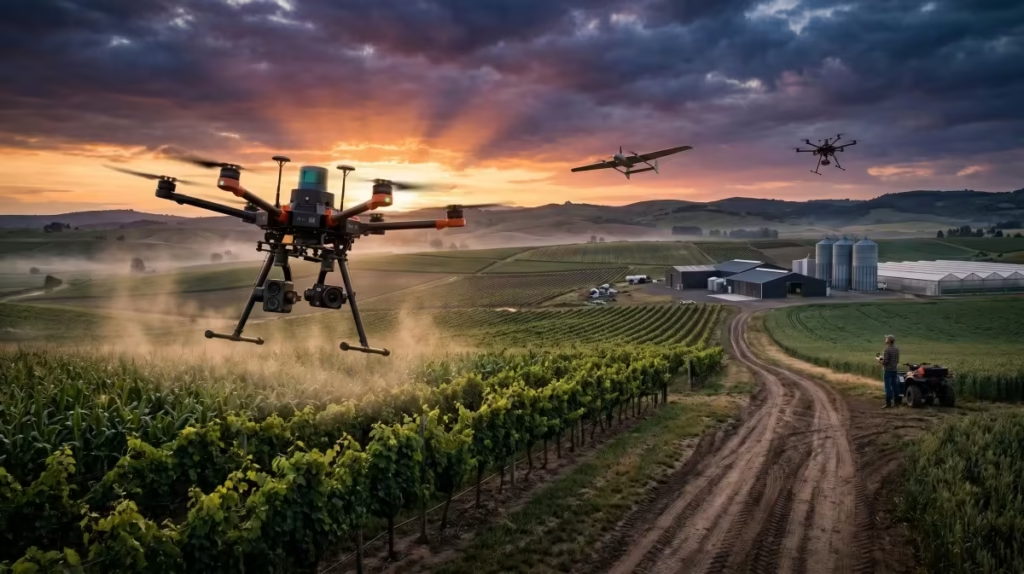
Monitoring drones carry multispectral camera sensors that capture light across wavelengths the human eye can’t see. Near-infrared bands reveal plant stress, nitrogen deficiency, and early disease symptoms that look like nothing from the ground but show up clearly as colour anomalies in a multispectral image. NDVI imaging, Normalised Difference Vegetation Index, translates that data into actionable crop health maps that farm managers can review and act on before problems spread.
Think about what that means in practice. A fungal infection starting in the northwest corner of a field might take two weeks to become visible to someone walking the rows. A monitoring drone flying over the same field on a Tuesday morning flags it as an anomaly by Tuesday afternoon. The farmer treats a 2-acre patch instead of a 40-acre plot.
DJI’s Mavic 3 Multispectral is one of the most widely deployed tools in this space, combining high-resolution imaging with NDVI mapping in a compact, relatively affordable platform that’s accessible to mid-sized farms, not just large commercial operations. Flight planning is automated; the drone flies its programmed grid, uploads data, and generates crop health reports with minimal operator input.
More than 500,000 agricultural drones have been deployed worldwide. According to research published in the journal Science and reported by The Conversation, their use has saved approximately 330 million metric tons of water and reduced carbon emissions by around 42.6 million tonnes, figures that capture the cumulative environmental impact of precision application replacing blanket treatment across millions of hectares.
Spraying Drones: Precision Application From the Air
Agricultural spraying drones apply inputs at a fraction of the volume of ground-based systems, targeting specific areas flagged by monitoring data rather than covering entire fields. DJI’s Agras T50 is the benchmark machine in this category right now.
It carries a 30-litre spray tank, covers wide swaths per flight, uses dual radar systems and binocular vision sensors for obstacle avoidance, and operates on automated flight plans that require minimal human oversight after deployment. In Brazilian coffee plantations, spray drones have been reported to reduce operational costs by up to 70% compared to conventional methods.
XAG’s R150 is another commercially significant platform designed for larger operations, with an emphasis on multi-machine coordination and fleet management from a single app.
You know what’s quietly interesting about farm drones? The monitoring and spraying functions are converging. Newer platforms increasingly scout first and spray second in a single operational pass. That integration is where farm drones are heading, and it’s going to make the separation between “observation” and “action” increasingly blurry in the next few seasons.
The agriculture drones market itself reflects this momentum. MarketsandMarkets values it at $2.63 billion in 2025, projected to reach $10.76 billion by 2030, a 32.6% compound annual growth rate, which is the fastest growth rate of any segment in agricultural robotics.
Livestock Robots: The Category Most People Forget About
Every conversation about farm robots eventually ends up in a field. Crops, drones, tractors- that’s where most of the coverage lands. But roughly a third of agricultural output globally comes from livestock operations, and robotics has been quietly transforming that side of farming for longer than most people realise.
Livestock robots don’t navigate unpredictable open fields. They work in more structured environments, such as barns, dairy facilities, and greenhouses, which means some of the hardest navigation challenges don’t apply. What they do instead is handle repetitive, time-critical, precision-dependent tasks that human workers have historically had to perform on livestock schedules, not human ones. Cows, for instance, don’t care that it’s 3 a.m.
The first robotic milking system was installed by Lely in the early 1990s. That’s not recent history; it’s over thirty years of refinement. This is part of why this technology works as reliably as it does today.
Robotic Milking Systems – 135,000 Machines, One Quiet Revolution
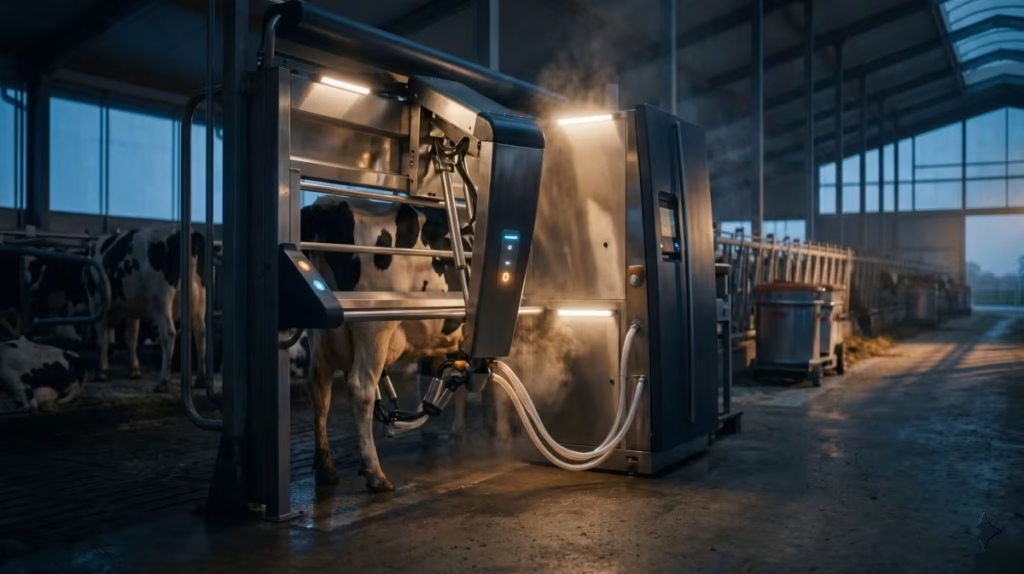
Lely’s Astronaut A5, the company’s current flagship milking robot, uses a laser-guided robotic arm to clean each cow’s udder and attach teat cups individually. The whole process is automated. The cow enters the milking station voluntarily; no scheduled milking time, no human intervention needed. A sensor collar identifies the animal, checks whether she’s due for milking based on her individual cycle, dispenses personalised feed to encourage her to stay, and initiates the milking sequence.
The operational impact on dairy farms is significant. Jan Jacobs, human-robot interaction design lead at Lely, has noted the direct relationship between reduced cow stress and higher milk production. Voluntary milking means cows come in when they’re ready, which turns out to be better for output than scheduled forced milking. Farmers using robotic milking systems consistently report improved herd health monitoring, earlier detection of mastitis and other conditions, and perhaps most valuably, the ability to sleep through the night without a 4 a.m. milking shift.
The milking robot market reflects this adoption. It’s growing steadily, driven by labor shortages in dairy regions across Europe, the United States, and increasingly in Asia-Pacific, where mechanisation of livestock operations is accelerating rapidly.
Greenhouse Robots – Farming Without Weather
Controlled environment agriculture greenhouses, vertical farms, and indoor growing facilities are one of the fastest-growing segments in modern food production. And it’s also one of the most robot-friendly environments in all of farming.
Here’s why. The core challenge for outdoor agricultural robots is unpredictability: changing weather, uneven terrain, variable light, and crops that look different every week. A greenhouse eliminates most of those variables. Temperature is controlled. Lighting is managed. Row spacing is consistent. The environment is designed for repeatability, which is exactly what robots need to perform reliably.
Transplanting robots handle one of the most labour-intensive stages of greenhouse production, moving seedlings from propagation trays into growing beds or containers at scale. Traditional transplanting is slow, physically repetitive work that’s difficult to fill with seasonal labour. A robotic transplanting system handles thousands of plants per hour with consistent spacing and depth, while sensors monitor for damaged or malformed seedlings that should be culled.
Beyond transplanting, greenhouse robots increasingly handle harvesting (tomatoes, cucumbers, and peppers are particularly active development areas), crop inspection using onboard cameras, and environmental monitoring tracking temperature, humidity, CO₂ levels, and growth metrics across large indoor growing spaces.
The convergence of greenhouse farming and AI in farming is producing something genuinely interesting: growing environments that are not just controlled but actively managed by machines responding to real-time plant data. Crop yield improvement in these settings is measurable and consistent in a way that outdoor farming, with all its variables, simply can’t match.
How to Choose the Right Type of Robot for Your Farm
Reading about all these robot types is one thing. Knowing which one actually makes sense for your operation is a different question entirely, and it’s one that most articles on this topic quietly sidestep.
There’s no universal answer. The right robot for a 500-acre grain farm in the American Midwest looks nothing like the right robot for a 20-hectare organic vegetable operation in southern France. But there are three questions that narrow the field quickly, regardless of where you farm or what you grow.
What is your primary pain point right now?
This is the most honest starting point. If seasonal labour availability is your biggest operational constraint and you have difficulty finding reliable workers during planting or harvest windows, then ground robots that can work autonomously overnight are the most direct solution. Autonomous weeding robots, seeding platforms like FarmDroid, and autonomous tractors for broad-acre work all target that specific problem.
If input costs are your main concern, herbicide, fertiliser, and water, then precision farming technology that reduces waste is where the return on investment is clearest. See & Spray-style systems, monitoring drones feeding into targeted treatment decisions, and soil-scanning robots that enable variable-rate fertilisation all address that cost profile.
If you’re a dairy or livestock operator, the labor conversation looks different again. Robotic milking systems don’t just save time; they change how the entire farm schedule is structured. That’s a bigger operational shift than adopting a field robot, but the productivity and well-being gains are well documented across 30 years of deployment data.
What scale are you operating at?
Scale matters enormously for robotics ROI. Most high-capability autonomous systems, commercial harvesting robots, full autonomous tractor setups, and multi-robot drone fleets are priced and designed for large commercial operations. A single Lely milking robot starts at roughly $150,000–$200,000. John Deere’s autonomous 8R is premium commercial equipment.
But the market is changing. Solar-powered robots like FarmDroid work effectively on fields as small as 20 hectares. Drone services are increasingly available on a per-acre contract basis, meaning smaller farms can access monitoring capabilities without capital investment. Robotics-as-a-service models, where you pay per operation rather than purchasing outright, are emerging specifically to make these tools accessible to mid-sized family farms.
What environment are you working in?
Open field crops, specialty crops in rows, orchards, vineyards, dairy barns, and greenhouses each suit different robot categories. If you’re growing in a controlled environment, greenhouse robots offer the best current performance-to-cost ratio because the predictable setting makes automation genuinely reliable. If you’re in open field row crops, ground weeding and seeding robots are the most mature and commercially proven category. Orchards and vineyards have their own specialist robots. Naïo’s TED for vineyards is a good example, specifically engineered for those environments.
Smart farming isn’t about adopting every robot type at once. It’s about identifying the one task in your operation that is most repetitive, most time-sensitive, or most dependent on labour availability and solving that first. The farms seeing the strongest results from agricultural robotics are the ones that started with a specific, well-defined problem rather than a general interest in technology.
What’s Next: The Farm Robot Types Still Being Built
The robots covered in this guide are the ones working on real farms right now, commercially deployed, field-tested, delivering measurable results. But the next generation is already in development, and some of it is genuinely worth paying attention to.
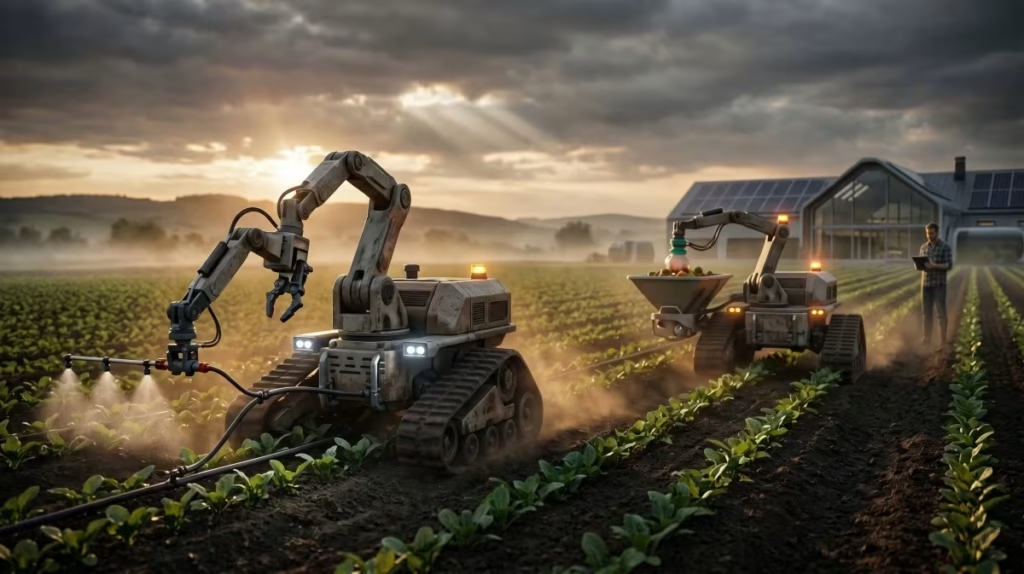
Multi-task robots are probably the most practical near-term development. Right now, most agricultural robots are specialists: a weeding robot weeds, a seeding robot seeds, a spraying drone sprays. The next generation of ground platforms is being designed to handle multiple tasks in a single pass. FarmDroid already points this direction: seed, weed, and micro-spray in one machine. But broader multi-task platforms that can shift between soil preparation, planting, monitoring, and targeted treatment based on real-time crop data are coming. One machine covering multiple roles changes the economics considerably for mid-sized operations.
Legged robots are an early-stage but genuinely interesting category. Wheeled and tracked robots struggle with very uneven terrain: steep vineyards, rocky orchards, waterlogged fields after heavy rain. Legged platforms, like those being developed from Boston Dynamics-style technology, can navigate terrain that defeats any wheeled system. Agricultural applications are still mostly in research phases, but the trajectory is clear.
AI-driven task switching is where the most ambitious development is happening. Rather than robots that execute pre-programmed tasks, researchers are working toward systems that observe field conditions continuously and decide autonomously what intervention is needed, adjusting from monitoring to targeted spraying to mechanical weeding based on what the sensors detect, without a human making the call. As Demis Hassabis, CEO of Google DeepMind, has noted: “AI will be one of the most transformative technologies in human history.” In agriculture, that transformation is looking less like a dramatic disruption and more like a steady accumulation of small, precise improvements, each one compounding on the last.
The broader picture is this: agricultural robots aren’t converging on a single solution. The diversity of farm environments, open fields, vineyards, orchards, greenhouses, and dairy barns means the diversity of robot types will always be necessary. What’s changing is the intelligence layer connecting them. Robots that communicate with each other, share field data, and coordinate tasks across categories are the direction the industry is heading.
For farmers, the practical message is simple. These tools are no longer experimental. They are commercially available, increasingly affordable, and in many cases delivering return on investment within two to three seasons. The question isn’t whether agricultural robots will become part of modern farming; they already are. The question is which types fit your operation, and in what order to adopt them.
If you want to understand how these machines actually find their way around a field, the GPS systems, the AI navigation layers, the obstacle avoidance that makes autonomous operation possible, our deep-dive on autonomous mobile robots in agriculture covers that technical layer in full. And for the broader picture of how precision technology is reshaping the entire farming operation from the ground up, our pillar article on precision agricultural robotics and autonomous farming is the place to start.
FAQs
1. How big is the agricultural robots market?
The global agricultural robots market was valued at $17.73 billion in 2025 and is projected to reach $56.26 billion by 2030, according to MarketsandMarkets. The agricultural drone segment alone is growing even faster, from $2.63 billion to $10.76 billion over the same period.
2. What is the difference between a monitoring drone and a spraying drone?
Monitoring drones carry multispectral cameras to detect crop stress, nutrient deficiencies, and early disease using NDVI imaging, helping farmers spot problems before they spread. Spraying drones apply fertilizer, herbicide, or pesticide directly, often targeting only the specific areas flagged by monitoring data rather than treating an entire field.
3. Do weeding robots use chemicals?
No. Most weeding robots are designed specifically to reduce or eliminate herbicide use. Carbon Robotics’ LaserWeeder identifies and eliminates weeds with lasers, while Naïo Technologies’ OZ and TED robots use mechanical tools like blades and tine harrows to remove weeds physically, both without chemical inputs.
4. Why are greenhouse robots more advanced than outdoor field robots?
Greenhouses offer controlled, consistent conditions, stable temperature, lighting, and row spacing, removing the unpredictability that challenges outdoor robots, such as changing weather and uneven terrain. This consistency makes tasks like transplanting and harvesting easier to automate reliably.
5. Can robots fully replace manual harvesting?
Not yet, especially for delicate crops like strawberries and tree fruit, where ripeness assessment and gentle handling remain difficult to automate at scale. Current systems like Agrobot and FFRobotics perform well in commercial settings, but performance still varies by crop and conditions, though the gap with manual picking is closing each season.
6. How much does an agricultural robot cost?
Costs vary widely by category. Robotic milking systems like Lely’s Astronaut A5 start around $150,000–$200,000, while autonomous tractors like John Deere’s 8R are premium commercial equipment. Smaller solar-powered units like FarmDroid’s FD20 are accessible to farms as small as 20 hectares, and many companies now offer robotics-as-a-service models with per-acre or per-operation pricing instead of outright purchase.