
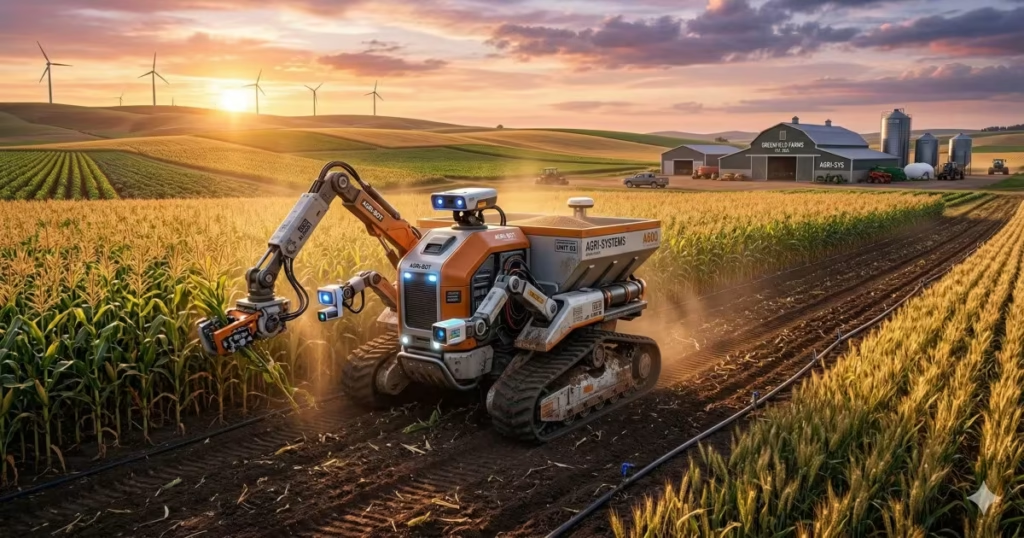
Farming isn’t what it used to be. Tractors still roll across fields, but now it’s changing rapidly. Drones buzz overhead, sensors peek from the soil, and some machines operate with no one in the seat. With rising food demand, unpredictable weather, shortage of water and shrinking labor pools, farmers need more Precision Agricultural Robotics & Autonomous Farming; in short they needs smart tools.
From targeted spraying and smart weeding to self-driving tractors and real-time crop monitoring, these technologies are helping farmers save time, cut costs, and make data-driven decisions, quietly transforming fields into intelligent, responsive ecosystems. That’s give farmer control over natural things.
From Tractors to Thinking Machines
Precision Agriculture Robotics in Agriculture has always evolved with technology. The mechanical tractor in the early 20th century changed everything. And then, one farmer could manage far more land. Productivity jumped. Efficiency improved. It was revolutionary.
Fast forward a few decades, and we saw GPS-guided tractors. That felt advanced at the time and it was. Systems from companies like John Deere began integrating satellite guidance so machines could drive in near-perfect straight lines. Fewer overlaps. Less wasted fuel. Better field coverage.
The real shift began when automation started creeping in quietly. Auto-steer became common. Yield monitors collected data during harvest. Soil sensors measured moisture. Farms slowly turned into data-generating ecosystems.
Unlike traditional farm equipment, agricultural robots aren’t just big machines with engines. They’re systems built around perception. Cameras. LiDAR. Multispectral imaging. Edge processors running machine learning models. These machines don’t simply move and they observe.
A traditional sprayer covers an entire field because that’s what it’s designed to do. A precision robot, on the other hand, scans plants individually. It distinguishes crops from weeds. It sprays only what needs treatment. That’s a completely different philosophy of farming.
It’s similar to how medicine evolved from general treatments to highly targeted therapies. Agriculture is also following a similar path. Less blind action, more calculated response.
Labor shortages in countries like the United States and parts of Europe are intensifying. Climate unpredictability demands faster decision-making. Input costs for fertilizers, pesticides, and fuel continue to rise. Farmers don’t just want bigger machines anymore. They want smarter ones.
That’s why autonomous systems are gaining traction. These machines don’t just follow pre-set paths. They adapt, avoid obstacles and map fields. Some even coordinate in fleets.
Take autonomous field operations introduced by CNH Industrial under brands like Case IH. The idea isn’t simply automation. It’s supervised autonomy machines working independently while farmers monitor remotely.
So when we talk about Precision Agricultural Robotics or Autonomous Robotics in Agriculture, we’re not describing a sudden revolution. We’re describing the natural next step in a long technological evolution.
Precision Agricultural Robotics Farming by the Centimeter
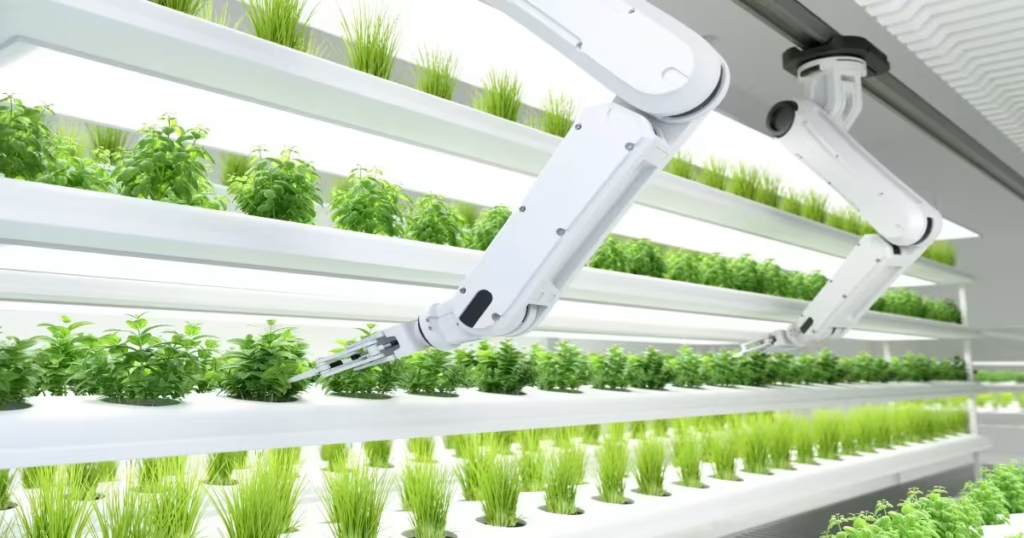
Here’s the thing: farming has never really been uniform.
One corner of a field holds more moisture. Another has slightly weaker soil. One patch attracts pests every single season, almost predictably. Yet for decades, farmers treated entire fields the same way. Same fertilizer rate, pesticide coverage, and irrigation cycle.
Precision Agricultural Robotics changes that equation completely. Instead of seeing a farm as one large surface, these systems treat it like a mosaic of thousands, sometimes millions, of micro-zones that each need slightly different care.
Think of it like modern medicine. Doctors don’t prescribe the same treatment to every patient. They diagnose first. Robotics brings that diagnostic mindset to farming.
So what does precision actually mean?
At a technical level, precision agricultural robotics combines:
- High-accuracy GPS (often RTK-level positioning down to centimeters)
- Computer vision systems
- Soil and crop sensors
- AI-driven decision models
- Robotic actuators that respond instantly
But that description feels clinical. Let’s make it practical.
Imagine a robotic weeder moving through a lettuce field. As it travels, onboard cameras scan each plant. A neural network trained on thousands of crop images identifies what’s lettuce and what’s weed. The robot activates a micro-sprayer or mechanical tool only when needed.
No blanket spraying. No unnecessary chemical spread.
That’s precision.
Companies like Naïo Technologies have built compact electric robots designed exactly for this kind of work. Quiet. Lightweight. Targeted. They don’t dominate the field like traditional machinery; they move through it carefully.
Even large-scale systems are shifting toward precision. Blue River Technology, now part of John Deere, developed “See & Spray” technology that identifies weeds in real time and applies herbicide only where necessary. In some cases, herbicide use drops dramatically.
Reducing chemical input isn’t just a cost-saving measure. It matters environmentally. Soil health improves. Runoff decreases. Regulatory pressure becomes easier to manage. Consumers who increasingly care about sustainability notice.
Beyond Weeding: Data as a Daily Habit
Precision agricultural robotics isn’t limited to spraying or weeding. It extends to:
- Variable-rate seeding (adjusting seed density based on soil quality)
- Smart irrigation systems reacting to moisture levels
- Targeted fertilization using nutrient mapping
- Disease detection using multispectral imaging
Drones, especially from companies like DJI, capture crop health data using NDVI imaging. That information feeds into farm management software. Robots and equipment then execute actions based on those insights.
It becomes a feedback loop.
Observe → Analyze → Act → Measure → Improve.
And here’s something interesting: precision often means doing less, not more. Fewer chemicals, water, overlap. But achieving more yield consistency.
It’s a subtle contradiction. You reduce input, yet performance improves. That’s the power of data-driven robotics.
Why Farmers Care About Precision
Farmers don’t invest in technology because it sounds futuristic. They care about margins. They care about predictability.
Precision agricultural robotics offers:
- Lower input costs
- Reduced waste
- Higher consistency across fields
- Better documentation for compliance
- Improved long-term soil health
It’s not flashy. It’s practical.
And honestly, that practicality is why precision systems are gaining traction faster than fully autonomous ones in some regions. They integrate gradually. They assist rather than replace.
But assistance eventually leads to independence. And that brings us naturally to the next step in this evolution.
Precision is about targeted action.
Autonomy is about decision-making without constant human oversight.
Autonomous Robotics in Agriculture
Precision is impressive. It sharpens farming down to the centimeter.
But autonomy? That changes the rhythm of the entire operation.
Here’s the difference in simple terms: precision robotics helps farmers make better decisions. Autonomous robotics makes certain decisions on its own.
That might sound small. It isn’t.
An autonomous agricultural robot doesn’t just follow a programmed path. It senses its environment, interprets what it sees, and adjusts behavior in real time. In technical language, it runs a perception–planning–action loop. In plain language? It thinks before it moves.
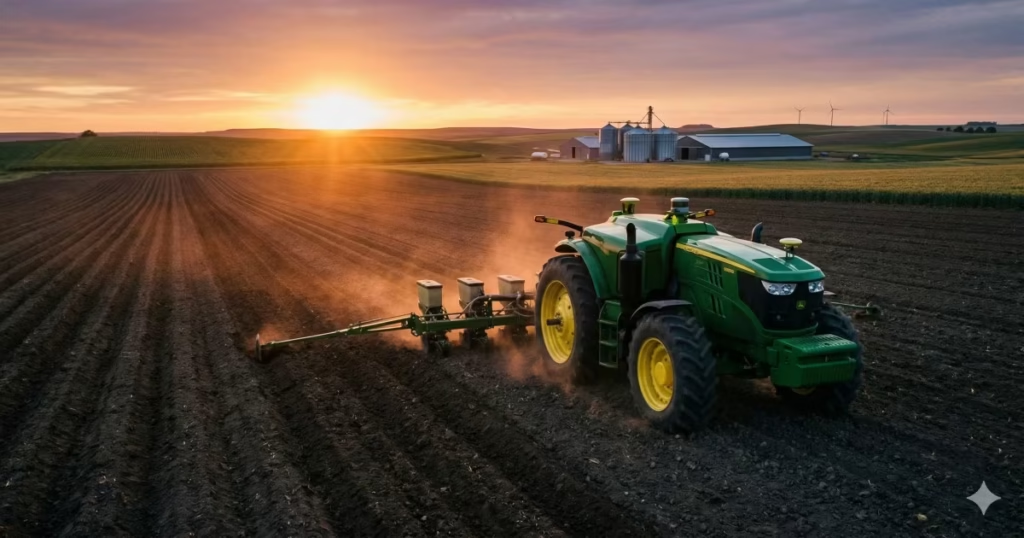
Picture an autonomous tractor operating at night. Cameras and radar scan the field ahead. AI models detect obstacles, rocks, animals, and unexpected debris. The system recalculates its route instantly, with no driver in the cabin. A farmer monitors remotely from a tablet, maybe from the farmhouse kitchen.
That’s not experimental anymore. John Deere introduced a fully autonomous tractor equipped with stereo cameras and deep-learning models that can detect obstacles in f360 degrees. It operates independently once deployed in the field.
And it doesn’t get tired.
What “Autonomous” Really Means
Autonomy exists on a spectrum. Not every system is fully independent.
Some machines are:
- Supervised autonomous – They operate alone but require human oversight.
- Task-autonomous – They perform specific functions independently (like harvesting).
- Fully autonomous – Minimal human involvement once deployed.
Agriculture is mostly in the supervised phase right now. And honestly, that makes sense. Farms are unpredictable environments, with mud, dust, uneven terrain, and sudden weather shifts. It’s not like a factory floor.
Still, progress is accelerating.
Companies like CNH Industrial, through brands such as Case IH, are pushing autonomous field platforms that can operate with minimal intervention. Meanwhile, startups are experimenting with swarm-style fleets, in which multiple smaller robots coordinate tasks instead of relying on a single massive machine.
It’s a fascinating shift. Instead of one giant tractor, imagine five compact robots working together like a team of disciplined workers moving in sync.
Ground Robots, Drones, and Everything in Between
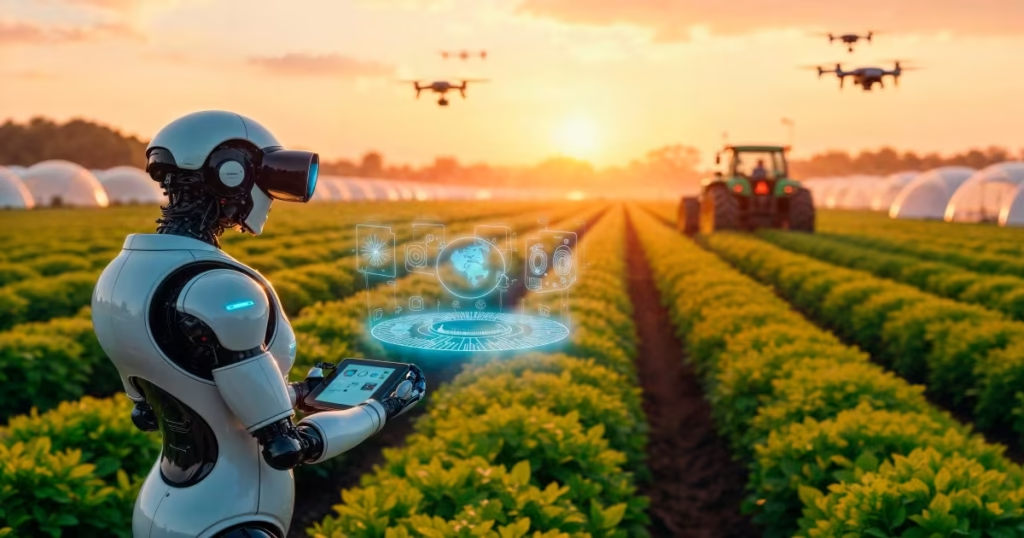
Autonomous robotics in agriculture generally falls into three categories:
1. Ground Robots (UGVs)
These handle tasks like:
- Weeding
- Seeding
- Harvesting
- Soil analysis
They navigate crop rows with precision, using LiDAR and machine vision.
2. Aerial Drones (UAVs)
Often semi-autonomous, they:
- Monitor crop health
- Map fields
- Perform targeted spraying
Advanced drone systems from DJI already integrate automated flight planning and obstacle avoidance.
3. Autonomous Tractors & Heavy Machinery
These combine traditional power with AI-driven navigation and remote supervision.
Each category plays a role. Together, they create something larger: an intelligent farm network.
The Real Impact – Time
Here’s what often gets overlooked: autonomy gives time back.
Farming doesn’t operate on office hours. During planting or harvest season, timing is everything. A delay of a few hours can mean yield loss. An autonomous system working overnight or during tight weather windows provides flexibility.
You know what? That flexibility might be the biggest advantage of all.
Of course, autonomy raises questions too. Reliability. Safety. Cost. Data privacy. And we’ll get to those challenges soon.
But for now, it’s clear that autonomous robotics isn’t science fiction. It’s operational, evolving, and slowly reshaping farm workflows.
Precision makes farming smarter.
Autonomy makes it continuous.
Real-World Applications – This Isn’t a Lab Experiment
It’s easy to talk about robotics in theory. Sensors, AI, autonomy, it all sounds impressive. But the real question is simple: what’s actually happening on farms right now?
Robotics in agriculture isn’t some distant pilot program hidden in research fields. It’s operating in orchards, vineyards, grain farms, and greenhouses across the globe. Sometimes quietly. Sometimes dramatically.
Precision Spraying, Less Chemical, More Accuracy
Traditional spraying systems treat an entire field uniformly. But weeds don’t grow uniformly. Neither do diseases.
That mismatch costs money.
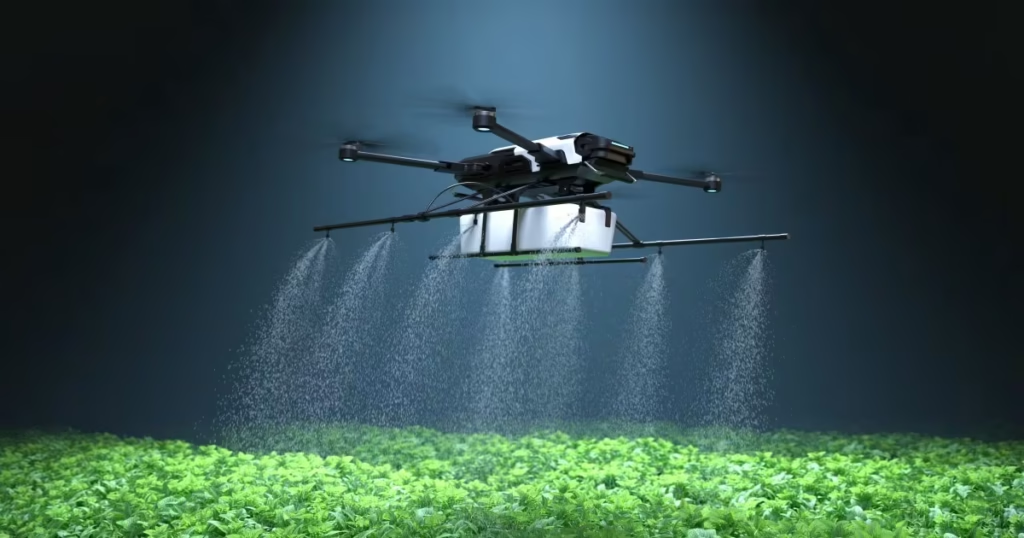
Systems like “See & Spray,” developed by Blue River Technology and acquired by John Deere, use computer vision to identify weeds in real time. Cameras scan each plant. Algorithms decide whether it’s a crop or a weed. Sprayers activate only when needed.
Farmers report lower chemical costs. Environmental impact decreases. And regulators who are increasingly strict about chemical runoff- notice the difference.
Robotic Weeding, Mechanical, Not Chemical
In organic farming especially, robotic weeders are gaining traction.
Machines from Naïo Technologies navigate crop rows autonomously, mechanically removing weeds without herbicides. Electric-powered. Lightweight. Designed to avoid soil compaction.
And here’s something subtle but important: smaller robots disturb soil less than heavy tractors. That can improve long-term soil health.
Autonomous Harvesting, The Hardest Task
Harvesting is complex. Crops aren’t uniform objects sitting neatly in rows. Fruits hide behind leaves. Ripeness varies.
Yet robotic harvesting systems are improving fast.
Companies like Agrobot have developed strawberry-picking robots using advanced vision systems. They assess ripeness, locate fruit, and pick gently without crushing it.
Is it perfect? Not yet. But performance improves season after season.
And in regions facing severe labor shortages, even partial automation reduces pressure.
Drone-Based Monitoring, Eyes in the Sky
Drones have become almost routine in modern agriculture.
Platforms from DJI perform automated field mapping, crop health analysis, and even precision spraying. Using multispectral cameras, they detect plant stress before the human eye can.
That early detection matters.
A disease caught early might affect one section of a field. Left unnoticed, it spreads. Robotics doesn’t replace human judgment; it enhances it with earlier signals.
Livestock Robotics, Yes, Even Animals
Crop farming gets most of the attention, but livestock operations are adopting robotics too.
Autonomous feeding systems, robotic milking stations, and health-monitoring collars are already common in advanced dairy farms. Companies like Lely produce robotic milking systems that allow cows to be milked voluntarily, reducing labor intensity and sometimes even improving animal welfare.
It sounds futuristic, but farmers using these systems often describe them as simply practical.
Less midnight labor. More consistent monitoring. Fewer human errors.
A Pattern Emerges
Across all these examples, one pattern stands out:
Robotics handles repetitive, time-sensitive, or precision-heavy tasks.
Humans handle oversight, strategy, and decision-making.
And that balance feels right. Technology doesn’t bulldoze tradition. It supports it.
But here’s the interesting part: all these systems rely on deeper technologies operating behind the scenes. AI models. Sensors. Connectivity layers. Without them, none of this works. The Technology Behind the Curtain
Alright, we’ve seen the machines in action. Now let’s talk about what actually powers them.
Because agricultural robots aren’t just metal frames with wheels. They’re layered systems. Hardware meets software. Sensors feed algorithms. Algorithms guide motors. It’s a tightly connected loop.
At the heart of most precision agricultural robotics systems sits artificial intelligence, particularly computer vision.
A field robot doesn’t “see” the way humans do. It processes pixel data, runs trained neural networks, and classifies patterns. A tomato plant, a weed, dry soil, and healthy leaf tissue become data categories. The model decides what action to trigger.
And those models are improving quickly.
Vision systems now combine RGB cameras, multispectral imaging, and sometimes LiDAR for depth perception. RTK GPS ensures centimeter-level positioning. Edge computing units process data directly on the machine, so it doesn’t rely entirely on cloud connectivity, which, let’s be honest, can be unreliable in rural areas.
Connectivity is still a challenge, though.
Many farms lack stable high-speed internet. That’s where hybrid systems shine. Some data is processed locally; summaries sync to cloud dashboards when connection allows. Farm managers can review analytics from a laptop, a tablet, sometimes even a phone.
It’s a quiet digital ecosystem forming beneath the surface.
And here’s something worth noting: agricultural robotics isn’t just about hardware companies. Software platforms, AI startups, and data analytics firms are equally important. The machine might operate in the field, but its intelligence often lives in code.
Why Farmers Are Actually Paying Attention
Technology adoption in agriculture is rarely impulsive. Farmers calculate risk carefully. Margins can be thin. Weather is unpredictable. Investment decisions carry weight.
So why are robotics systems gaining traction?
Let’s break it down.
Labor shortages are a major driver. Seasonal labor is harder to secure in many regions. Immigration policies, urban migration, and demographic shifts all play a role. Autonomous systems don’t eliminate human labor, but they reduce dependency during peak seasons.
Input costs keep rising. Fertilizers, pesticides, fuel, none of it is getting cheaper. Precision systems that reduce waste directly protect margins.
Sustainability pressure is growing. Retailers and consumers demand traceability and environmental responsibility. Robotics provides data trails. Every spray pass. Every irrigation adjustment. Documented.
And then there’s consistency.
Humans get tired. Machines don’t. A robot performs the thousandth weed removal with the same precision as the first. That repeatability matters in large-scale operations.
Still, farmers aren’t blindly optimistic. They test, compare ROI, and calculate payback periods.
Robotics earns attention when it proves itself season after season.
The Challenges Nobody Loves to Discuss
Agricultural robotics sounds impressive, but adoption isn’t frictionless.
Cost is the first barrier. Advanced autonomous tractors or robotic harvesters require significant capital. For small farms, that investment can feel risky.
Field conditions are unpredictable. Dust, mud, rain, and extreme heat in agricultural environments are harsh. Electronics must survive all of it.
Technical reliability is another factor. A system failure during harvest isn’t just inconvenient. It’s costly.
And then there’s the human side.
Technology adoption requires training. Farmers and farm workers must trust the system. There’s sometimes understandable hesitation about letting machines operate independently.
Data ownership raises questions too. Who controls farm data? How is it stored? Those discussions are ongoing.
So yes, robotics offers major advantages. But it’s not plug-and-play perfection.
That tension between promise and practicality is shaping the current phase of adoption.
What the Future Might Look Like
Now here’s where things get interesting.
The next wave of agricultural robotics isn’t necessarily about bigger machines. It’s about coordination.
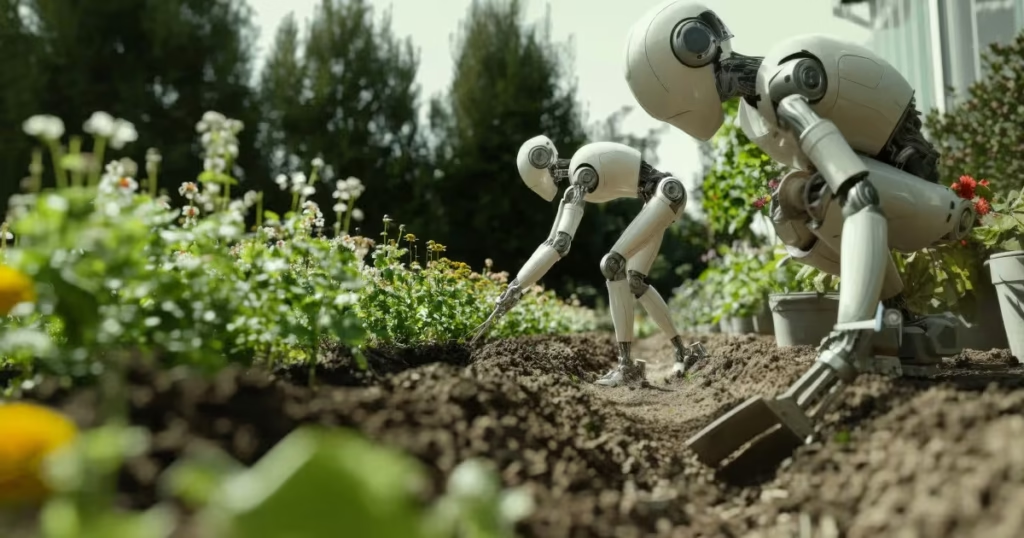
Swarm robotics, multiple small robots working together, is gaining attention. Instead of one massive tractor compacting soil, imagine lightweight units moving cooperatively across a field.
Artificial intelligence will continue improving disease prediction and yield forecasting. Robotics will increasingly act based on predictive models, not just reactive sensing.
Autonomous systems may operate 24/7 during critical windows. Charging stations powered by renewable energy could support electric fleets. Integration with climate-smart farming strategies will likely deepen.
Will we see fully autonomous farms? Possibly, but probably in stages.
Humans won’t disappear from agriculture. Strategy, oversight, and adaptation still require judgment. Robotics will augment those roles.
In many ways, the future farm looks less like a factory and more like an intelligent ecosystem.
Final Thoughts
Robotics in agriculture isn’t about replacing tradition. It’s about strengthening it.
Precision Agricultural Robotics brings accuracy.
Autonomous Robotics in Agriculture brings independence.
Together, they create resilience.
Farms face mounting pressure from climate change, labor shifts, and economic volatility. Robotics doesn’t solve every challenge, but it offers tools that were unimaginable just a generation ago.
And perhaps the most important point is this: the transition is gradual.
Fields won’t suddenly become fully robotic. Instead, sensors get added. Automation increases. Decision systems improve. Year by year.
For innovators, engineers, and researchers, this space is wide open. There’s room for better perception models. More affordable hardware. Smarter fleet coordination. Stronger rural connectivity solutions.
For farmers, it’s about practical value. Reduced waste. Stable yields. Reliable systems.
The story of robotics in agriculture is still being written. And it’s not a flashy tech narrative. It’s steady. Grounded. Field-tested.
Machines are becoming more intelligent. Farms are becoming more data-driven. Agriculture, one of humanity’s oldest industries, is quietly entering a new era.
FAQs
1. What’s the difference between precision robotics and autonomous robotics in farming?
Precision robotics improves the accuracy of what a farmer does, spraying, seeding, and irrigating, by targeting action to exact spots. Autonomous robotics goes a step further by removing the need for constant human input: the machine perceives its environment, makes decisions, and adapts in real time. Most farms today use supervised autonomy, where robots operate independently but a farmer monitors remotely.
2. Which farming tasks are robots actually being used for right now?
Robotic systems are already active in: precision spraying (John Deere’s See & Spray), mechanical weeding (Naïo Technologies), fruit harvesting (Agrobot’s strawberry pickers), drone-based crop monitoring and health mapping (DJI platforms), and dairy farming (Lely’s robotic milking stations). These aren’t pilot programs; they’re operating commercially across orchards, vineyards, greenhouses, and grain farms.
3. How does precision robotics actually save farmers money?
The savings come from multiple angles: herbicide use drops significantly when spraying is targeted only at weeds; water consumption decreases with smart irrigation tied to real soil moisture data; fuel efficiency improves with GPS-optimized paths; and labor costs during peak seasons are reduced. Less input, more consistent output, that’s the core financial case.
4. Can these robots work in fields with poor internet connectivity?
Yes, this was a deliberate design consideration. Most agricultural robots use edge computing, meaning AI models run directly on the machine using local processing power. Only summaries and analytics need to sync to the cloud, which can happen whenever a connection is available. This hybrid approach makes them practical in rural areas where stable high-speed internet is uncommon.
5. Do agricultural robots completely replace farm workers?
No, and that’s not the goal. The pattern that emerges across real-world deployments is that robots handle repetitive, time-sensitive, or precision-heavy tasks, while humans focus on oversight, strategy, and judgment. Autonomy reduces dependency on seasonal labor during peak windows (like harvest), but farms still need skilled operators and managers who understand the systems.
6. Is precision farming actually better for the environment?
Evidence points to yes. Targeted spraying reduces chemical runoff into soil and waterways. Smart irrigation cuts water waste. Smaller electric robots (like those from Naïo Technologies) compact soil less than heavy tractors, which supports long-term soil health. Less chemical input, combined with detailed data trails for compliance reporting, also makes it easier for farms to meet growing sustainability and regulatory standards.
7. How far away are fully autonomous farms with minimal human involvement?
The transition is gradual, not a single leap. Today’s farms are adding sensors, increasing automation layer by layer, and deploying supervised autonomous systems. Fully autonomous farms, where minimal human intervention is needed, may emerge in stages over the coming decades, starting in controlled environments like greenhouses and expanding outward. Human judgment for strategy, oversight, and adaptation isn’t disappearing anytime soon; the role is shifting more than shrinking.