
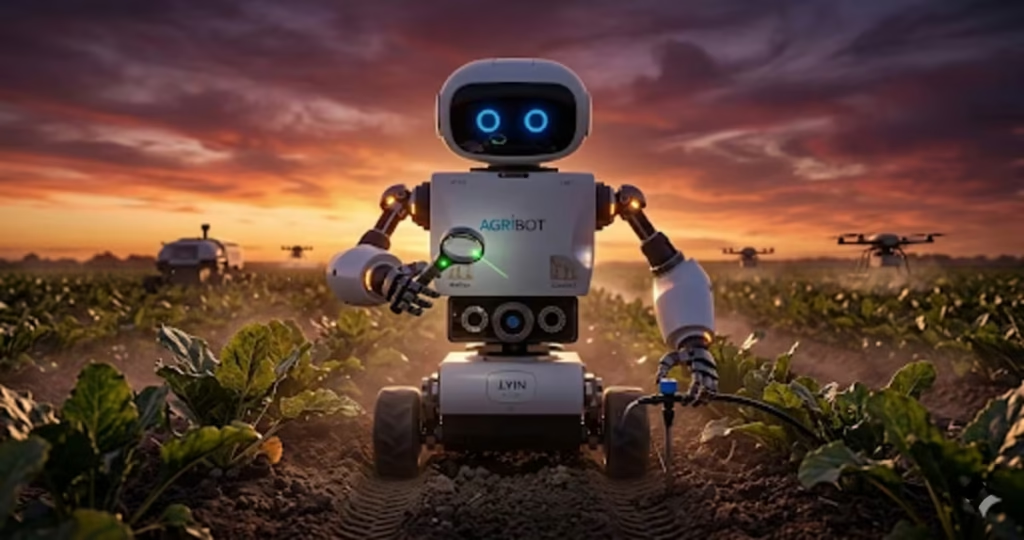
Picture a foggy morning in a strawberry field in southern Spain. No tractor engine rumbling. No farmworker walking the rows. Just a compact, quiet machine rolling steadily between the plants, scanning, adjusting, moving forward. It knows exactly where it is. It knows what’s a weed and what’s a crop. It hasn’t made a single mistake in six hours.
And here’s the thing: navigating a farm field is genuinely one of the hardest problems in robotics. It’s not like guiding a robot through a warehouse with flat floors and painted lines. A field changes. The soil shifts after rain. Plants grow taller week by week. Light drops behind a cloud, and the whole visual environment changes in seconds. Yet these machines handle it.
The numbers back this up. The global agricultural robots market was valued at around $7.5 billion in 2022 and is projected to exceed $20 billion by 2030, according to Grand View Research. That’s not hype; it’s investment following results.
Autonomous robotics in agriculture is quickly moving from “interesting pilot project” to standard practice on farms dealing with rising labor costs, shrinking water budgets, and growing pressure to reduce chemical use. Precision agriculture created the data layer. Robot automation is now acting on it.
What Exactly Is an Autonomous Mobile Robot and Why Does Farming Need One?
An autonomous mobile robot, or AMR robot, in short, is not the same as a remote-controlled machine. It’s not a GPS-guided tractor following a pre-programmed straight line. And it’s definitely not a drone someone’s piloting from a tablet at the field edge. The difference matters more than most people realise.
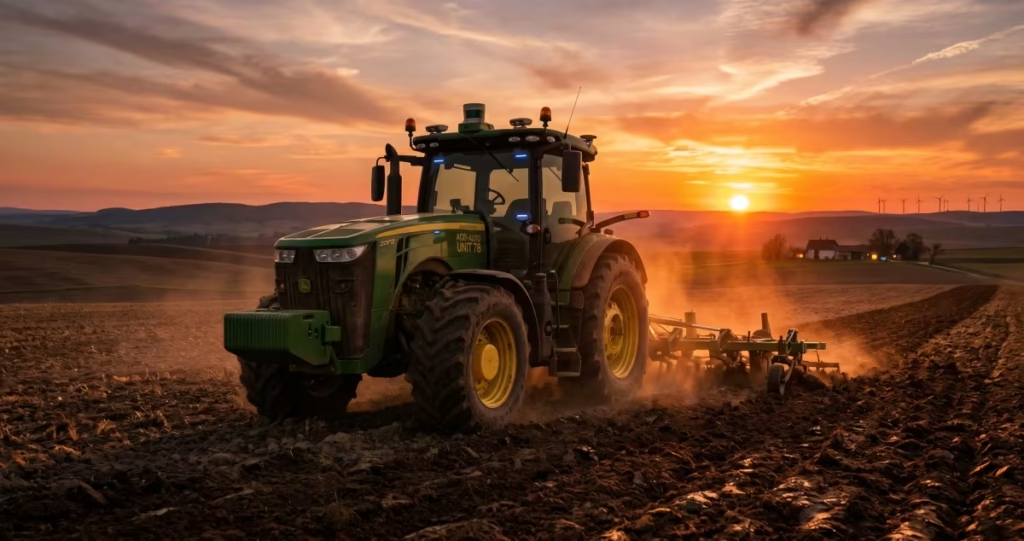
Here’s a simple way to think about it. A GPS-guided tractor is like a car with cruise control and lane assist; it follows a set path, and a human is ultimately in charge. An autonomous mobile robot is closer to a self-driving car. It perceives what’s around it, makes decisions based on what it finds, and acts all without someone telling it what to do moment to moment.
Three things define a true AMR:
- It perceives. With cameras, LIDAR sensors, and GPS, the robot is constantly reading its environment.
- It plans. Based on what it sees, it calculates the best path forward, avoiding obstacles and staying on task.
- It acts. It performs spraying, weeding, and scanning, and adjusts if something unexpected appears.
In farming specifically, these robots are classified as UGVs, unmanned ground vehicles. They move through fields on wheels, tracks, or legs (yes, legged robots exist in agriculture too, though they’re still rare). The key difference from industrial AMRs is that agricultural UGVs must operate in completely unstructured environments. No walls. No fixed routes. No predictable surface.
| Traditional Tractor | GPS-Guided Tractor | Autonomous Mobile Robot | |
|---|---|---|---|
| Human required? | Yes, always | Yes, for oversight | Minimal to none |
| Navigates obstacles? | Manual only | No | Yes, automatically |
| Adapts in real time? | No | Limited | Yes |
| Works overnight? | Rarely | Sometimes | Yes |
| Decision-making? | Human | Pre-set path only | On-board AI |
That table probably makes it obvious why the agricultural industry is paying attention. A machine that can work through the night, reroute around a rock, and adjust its spray pattern based on what it sees is not a marginal upgrade. It’s a fundamentally different way of running a farm operation.
According to a 2023 report by the Food and Agriculture Organization, over 40% of agricultural labor in developing economies is still done manually. That gap between what needs doing and who’s available to do it is exactly where autonomous mobile robots in agriculture are stepping in.
How Autonomous Mobile Robots Navigate Farm Fields: The 3-Layer System
Every autonomous mobile robot navigating a farm field is running three overlapping processes simultaneously. Perceiving what’s around it. Planning where to go. Acting on that plan and adjusting when reality doesn’t cooperate. These three layers don’t run one after the other; they run together, constantly, in a loop. Miss one, and the robot either stops working or does something expensive to fix.
Layer 1 — Perception: How the Robot Sees the Field
Before a farm robot moves a single centimetre, it has to understand where it is and what’s around it. That sounds straightforward. In a field at 6 am with dew on the camera lens and uneven soil underfoot, it really isn’t.
Most agricultural AMRs today use a combination of sensors rather than relying on a single sensor. RTK GPS (Real-Time Kinematic positioning) gives the robot its location to within 2 centimetres. That’s not the standard GPS on your phone, which is accurate to about 3 metres. RTK GPS uses a fixed base station and a moving receiver to calculate position with extraordinary precision. FarmDroid’s FD20 seeding and weeding robot, for example, uses RTK GPS to place seeds and remove weeds with 8 mm accuracy. Eight millimetres. On a field the size of multiple football pitches.
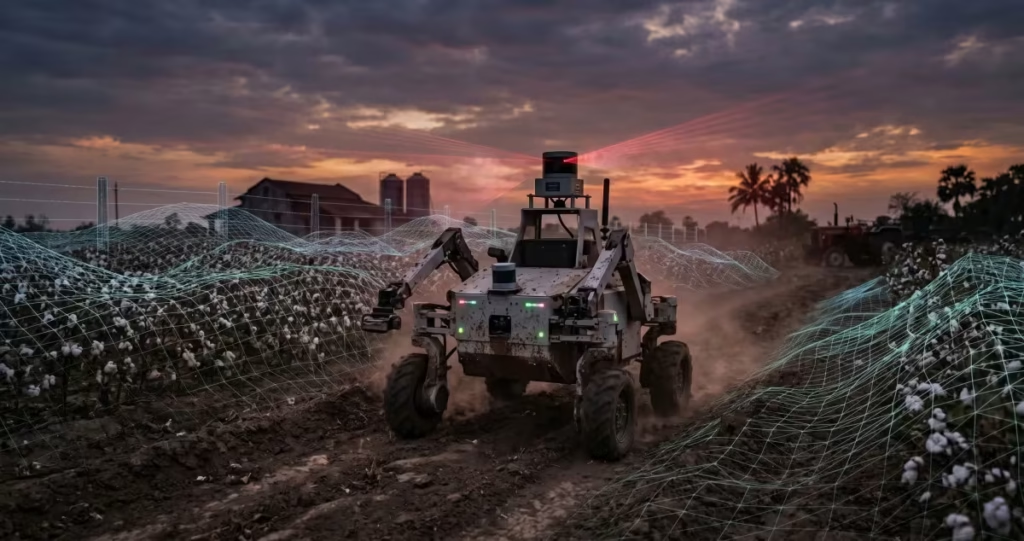
LiDAR navigation handles the 3D picture distance, depth, and obstacles. It fires laser pulses and measures how long they take to bounce back, building a real-time map of the space around the robot. Cameras add visual detail: what colour is that plant? Is that leaf shape a weed or a crop seedling?
And here’s where it gets interesting. No single sensor is reliable enough on its own. RTK GPS can lose signal under dense crop canopies. Cameras struggle in low light or direct glare. LiDAR can be confused by dust or heavy rain. So modern systems use multi-sensor fusion combining all inputs simultaneously, cross-checking each against the others, so if one feed goes noisy, the others compensate. It’s similar to how humans use sight, balance, and spatial memory together when navigating somewhere unfamiliar in the dark.
Layer 2 — Planning: How the Robot Decides Where to Go
Path planning in agricultural robots works on two levels at once, and this is something researchers at the University of Georgia confirmed in a 2024 study on autonomous navigation in cotton fields. GPS acts as the global planner, giving the robot a broad map of the field and a general route. Computer vision and deep learning models act as the local planner, making real-time, metre-by-metre decisions about exactly where to steer based on what the cameras are seeing right now.
Crop row detection is a big part of this. The robot identifies the gap between plant rows and keeps itself centred within it. If a plant has grown wider than expected, or if a branch has fallen across the path, the local planner catches it and reroutes without any human input.
Obstacle avoidance runs alongside all of this. A stray irrigation pipe, an animal, a patch of waterlogged soil that would bog the robot down in the planning layer, weigh those against the task objective, and pick the safest, most efficient response. According to research published in Science Direct in 2025, modern agricultural navigation systems can maintain positional accuracy within ±5 centimetres during autonomous bed navigation, even across uneven terrain.
Layer 3 — Action: How the Robot Executes Without Losing Its Head
This is where edge computing becomes critical. Most farm environments have patchy internet at best. Running navigation decisions through a remote cloud server would introduce lag that makes real-time adjustment impossible. So agricultural AMRs process the vast majority of their decisions locally, on hardware mounted directly on the machine. The brain travels with the robot.
Robot automation at this level means the machine isn’t just following instructions; it’s monitoring its own performance. Is the spray nozzle clogged? Has wheel slip changed the odometry reading? Is the battery dropping faster than the task map predicts? The action layer catches these things, and either corrects for them or flags a human operator remotely.
This is also where the perception–planning–action loop closes. Every action the robot takes generates new sensory data, which feeds back into perception, which updates the plan. It’s continuous. It never stops. And on a well-designed system, it runs faster than any human could manage, typically processing sensor inputs and making navigation micro-adjustments several times per second.
What Farm Robots Are Actually Doing on Fields Right Now
Theory is one thing. But farmers don’t buy theory, they buy results. So let’s look at what autonomous mobile robots in agriculture are actually doing on real fields, with real crops, right now.
Three areas stand out. Not because they’re the only ones, but because they show the range of what navigation technology makes possible when it’s applied well.
Autonomous Weeding , Naïo Technologies
Naïo Technologies, a French agricultural robotics company founded in 2011, builds some of the most widely deployed weeding robots in the world. Their Oz robot works in vegetable crops. Their Ted robot handles vineyards. Both are fully electric, lightweight, and designed to move through crop rows without compressing the soil the way a heavy tractor would.
Ted is a good example of the navigation system in action. It uses RTK satellite navigation to stay on course, and drones are used beforehand to map the plot it’s about to work. Once deployed, it rolls over and around vine rows shaped almost like an upside-down U, running blades along the base to remove weeds mechanically, without herbicide. No chemicals. No soil compaction from heavy machinery. No one is in the seat.
You know what’s quietly remarkable about this? The robot isn’t just saving labor. It’s doing the job more gently than a tractor could. Farmers using Naïo systems report better long-term soil health partly because the machines are lighter and their navigation is precise enough to stay consistently between rows rather than occasionally clipping plants or running wide.
Precision Spraying – Blue River Technology (John Deere)
Blue River Technology’s See & Spray system, now part of John Deere, is probably the most commercially scaled example of computer vision navigation in agriculture today. The system mounts on a standard sprayer and uses cameras and machine-learning models to scan plants in real time as the sprayer moves through the field.
Here’s the practical result: it identifies individual weeds among crops and activates spray nozzles only over the weed, not the surrounding area. John Deere reports that See & Spray can reduce non-residual herbicide use by up to two-thirds compared to broadcast spraying. On large-scale cotton and soybean operations, that’s not a small saving; it’s a significant shift in input cost and environmental impact per season.
The navigation challenge here is speed. The machine is moving at field pace while the vision system has to identify, classify, and trigger a response within milliseconds. It’s the action layer of the AMR system working at its most demanding, processing data and executing physical responses faster than any human operator could.
Autonomous Seeding and Scouting- FarmDroid FD20
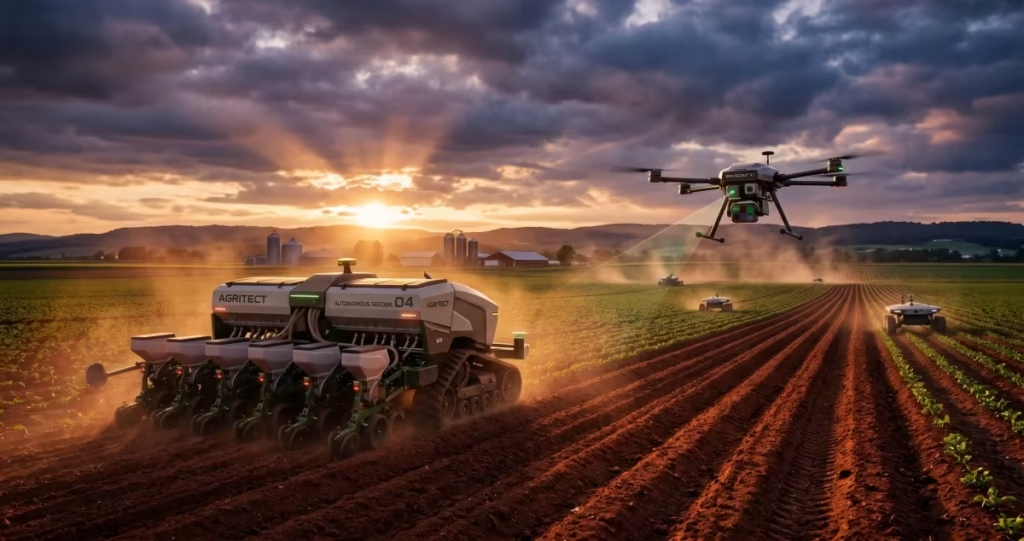
FarmDroid’s FD 20 is worth paying attention to because it challenges a common assumption that agricultural robots need to be fast to be useful. The FD20 is slow, deliberate, and solar-powered. It works around the clock, running on sunlight during the day and battery reserves overnight.
It seeds and weeds sugar beet, spinach, and other row crops using RTK GPS navigation with that 8 mm positioning accuracy mentioned earlier. Because it places each seed precisely, it also knows exactly where every plant is, which means when it returns to weed, it doesn’t need to use cameras to find the crops. It already has the map. The plants are exactly where it put.
FarmDroid reports that farms using the FD 20 have reduced herbicide use by up to 94%. As a field scouting robot, it also gathers environmental data continuously, soil temperature, moisture, and growth stage feeding information back to the farm management system.
Why Navigating a Farm Field Is Harder Than Navigating a Warehouse and How AMRs Solve It
Here’s something that doesn’t get said enough: an AMR robot designed for a warehouse and an AMR robot designed for a field are solving completely different problems. The word “autonomous” covers both, but the engineering challenge underneath is in a different league entirely.
Warehouse AMRs, the kind Amazon and Ocado use, operate in controlled environments. The floor is flat, sealed, and consistent. The lighting is fixed. The obstacles are predictable, shelves in known positions, and other robots following known routes. The whole space is essentially designed around the robot’s limitations. Engineers build the environment to suit the machine.
The soil changes texture from one end of the field to the other. A wheel that gets reliable traction on dry clay in August sinks three inches into the same ground after two days of rain in September. The “path” between crop rows isn’t a painted line; it’s a gap between living plants that grows narrower every week as the season progresses. Light shifts by the hour. Dust and pollen coat camera lenses. An irrigation pipe that wasn’t there yesterday is there today.
This is precisely why smart farming technology in agriculture has had to develop differently from industrial robotics. The perception systems are more redundant, with multiple sensor types cross-checking each other because no single sensor is trustworthy enough on its own. The path planning algorithms are more adaptive and built to handle terrain that changes rather than terrain that stays fixed. The hardware is ruggedised in ways warehouse robots simply don’t need to be: sealed against dust and moisture, capable of operating in temperatures from near-freezing to 45°C in direct sun.
There’s also something subtler going on with navigation confidence. A warehouse AMR knows its environment is static between shifts. An agricultural AMR has to treat its environment as permanently uncertain, always scanning, always updating its internal map, never assuming that what was true five minutes ago is still true now. Researchers at MDPI describe this as operating in “dynamic and unstructured environments,” which is accurate but undersells how genuinely difficult it is to engineer for.
The solution agricultural robotics companies have landed on isn’t one clever fix; it’s layered redundancy. GPS for global positioning. LiDAR for local 3D mapping. Vision systems for plant-level detail. Edge computing so decisions don’t depend on a rural Wi-Fi signal. Each layer covers the weaknesses of the others.
Agricultural automation in 2025 is, in many ways, ahead of warehouse robotics in the sophistication of its navigation systems precisely because the problem was harder to begin with. Necessity pushed the engineering further.
Swarm Navigation: When Multiple Farm Robots Coordinate as One System
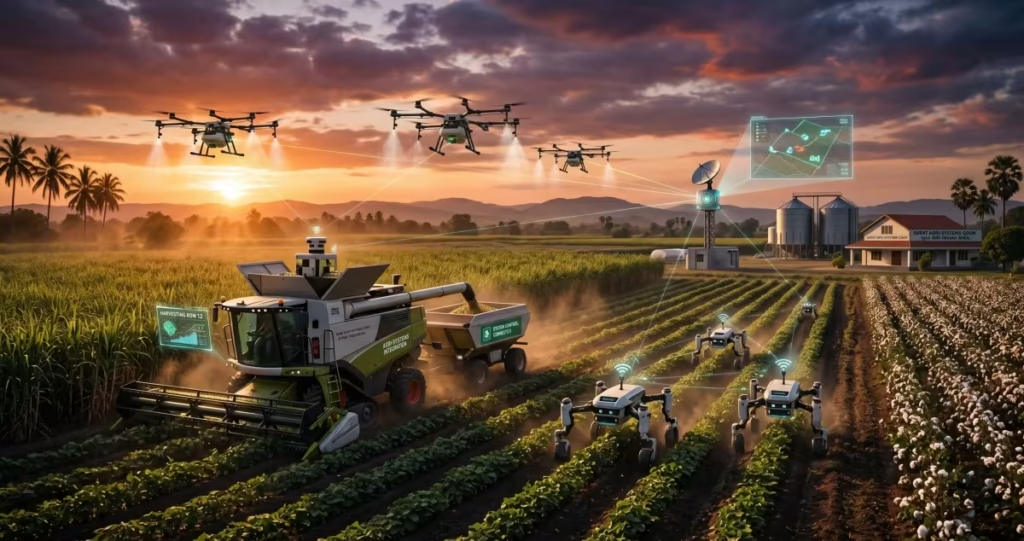
Most of the robots we’ve talked about so far work alone. One machine, one field section, one task. That model works well, but it has a ceiling. A single robot, however capable, can only cover so much ground before the economics stop making sense for larger operations.
The idea is straightforward, even if the engineering isn’t. Instead of one large, heavy machine doing everything, you send multiple smaller robots into the field simultaneously. They divide the work between them, coordinate their routes to avoid overlap, communicate their positions to each other, and collectively complete a task faster and with less soil damage than a single large machine ever could.
Think of it the way a team of surveyors works a large plot. No single person tries to map the whole thing alone. They split it into zones, work in parallel, and check in with each other at intervals to make sure the overall picture stays coherent. Swarm robots do essentially the same thing, except the “checking in” happens wirelessly, dozens of times per second.
Fendt’s Xaver system is the clearest real-world example of this right now. Xaver is a fleet of small, lightweight seeding robots, each one roughly the size of a large lawnmower, that work a field together. A farmer sets the field boundaries and crop parameters through a tablet interface, then deploys the fleet. The robots automatically divide the field into individual work zones, navigate their assigned areas using GPS and onboard sensors, and seed with consistent precision throughout the operation. No single robot needs to know what the others are doing in detail; they just need to know where they are and where they’ve been.
The navigation challenge in swarm systems is meaningfully different from single-robot navigation. Each robot still needs to handle its own perception–planning–action loop. But on top of that, the fleet needs collision avoidance between robots, not just between robots and the environment. It needs task reallocation if one robot’s battery drops unexpectedly, the others need to redistribute its uncompleted zones without a human stepping in. And it needs a coherent, shared map of the field that all robots contribute to and read simultaneously.
There’s a practical argument beyond the technology, too. Smaller robots mean less soil compaction. A fleet of five 200 kg robots distributes ground pressure far more gently than a single 10-tonne tractor. For farmers who’ve watched decades of heavy machinery gradually degrade their soil structure, that matters enormously. Some agronomists argue it matters as much as the precision of the work itself.
As Fei-Fei Li, co-director of Stanford’s Human-Centered AI Institute, put it: “AI is not about replacing humans, it’s about augmenting human capability.” Swarm robotics in farming embodies exactly that. One farmer, monitoring a tablet, is overseeing a coordinated fleet working through the night. The human is still central, just working at a completely different scale than before.
Autonomous harvesting is the next frontier for swarm systems. Harvesting is harder than seeding or weeding fruit ripeness varies, picking requires gentle manipulation, and row crops don’t ripen uniformly across a field. But several companies, including Tortuga AgTech and Agrobot, are already deploying multi-robot harvesting systems that split picking tasks across fleets, with each robot handling a section and a shared system tracking overall progress.
Navigation Challenges AMRs Still Haven’t Fully Solved
Honesty deserves a place in every good article. And honestly, autonomous mobile robots in agriculture are impressive, but they’re not perfect. There are real, stubborn navigation challenges that engineers are still working through, and farmers considering these systems deserve to know what they are.
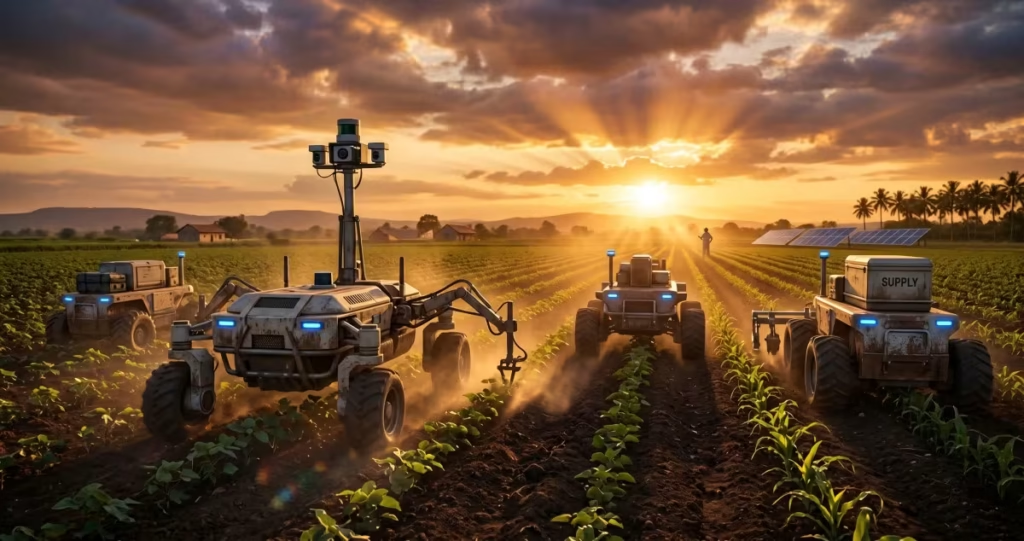
GNSS signal loss under dense canopies is one of the most consistent problems in the field. RTK GPS works brilliantly in open ground. But tall crops, maize and sunflowers, dense orchards can block or degrade satellite signals significantly. When that happens, the robot has to fall back entirely on its visual and LiDAR systems for positioning. Those systems are good, but they introduce more accumulated error over distance. A robot that’s accurate to 2cm in an open field might drift to 10–15cm accuracy under a dense maize canopy. For some tasks, that’s acceptable. For precision seeding or targeted micro-spraying, it isn’t.
Visual navigation failure in difficult light conditions is the second major challenge. Cameras, however good, struggle at dawn and dusk when light is transitioning fast. Heavy rain scatters LiDAR pulses and blurs camera feeds simultaneously. Direct midday glare in summer washes out visual contrast between plants and soil. Most systems manage these conditions reasonably well individually, but combinations of rain plus low light, dust plus heat shimmer can push even well-designed perception systems to their limits.
There’s also the crop reconfiguration problem, which doesn’t get discussed enough. An agricultural AMR is typically trained and calibrated for specific crops in specific row configurations. Switching from lettuce to brassicas, or changing row spacing between seasons, often requires significant reprogramming and recalibration. That’s time and expertise most small farms don’t have sitting around. The farm labor shortage driving the adoption of these robots is the same reason there aren’t enough trained technicians to support them easily when they need adjustment.
Rural connectivity gaps remain a genuine constraint on remote monitoring. Most AMR systems today process navigation decisions on board through edge computing, which solves the real-time problem. But farm managers still rely on data connectivity to monitor fleet status, receive alerts, and review daily performance logs. In large parts of India, sub-Saharan Africa, and even rural areas of Europe and the United States, that connectivity is unreliable enough to create real operational friction.
And then there’s cost. A fully equipped autonomous weeding or spraying robot from an established manufacturer currently runs anywhere from $50,000 to well over $150,000, depending on capability and scale. For a large commercial operation, the return on investment calculation works out within a few seasons. For a mid-sized family farm, it’s a harder conversation, especially when the technology is still evolving quickly enough that this year’s model could look dated in three years.
None of these challenges is insurmountable. The trajectory of GNSS agriculture technology is towards better multi-constellation receivers that are less affected by canopy interference. Vision systems are getting more robust through training on larger, more diverse agricultural datasets. Costs are falling as production scales up. The farm labor shortage itself is creating economic pressure that accelerates solutions.
What the Next Generation of Farm AMRs Will Look Like
We’re at an interesting inflection point right now. The first generation of autonomous mobile robots in agriculture proved the concept, showing that machines could navigate real fields, do real work, and deliver measurable results. The next generation is going to be about doing all of that smarter, cheaper, and at a scale that makes sense for farms of every size, not just the large commercial operations that could afford to be early adopters.
AI-enhanced predictive navigation is probably the most significant shift coming. Current systems are largely reactive; the robot sees an obstacle and avoids it, sees a weed and sprays it. Next-generation systems will be anticipatory. By combining historical field data, crop growth models, and weather inputs, the robot will plan its route based on what the field is likely to look like, not just what it sees in real time. It’s the difference between a driver who reacts to a pothole and one who already knows the road and steers around it before it appears.
Solar-powered continuous operation is already happening. FarmDroid’s FD20 points the way, but it’s going to become far more common. A robot that recharges itself during daylight and works through the night completely changes the economics of agricultural automation. Seasonal windows for planting and harvesting are brutally short. A machine that operates 24 hours a day without a fuel stop or a driver’s rest break is genuinely valuable in a way that’s hard to overstate. According to projections from MarketsandMarkets, the agricultural robots market will grow at a compound annual rate of around 24% through 2027, and energy-autonomous field robots are expected to be a major driver of that growth.
Deeper integration with farm management software will make AMRs less like standalone machines and more like connected nodes in a farm-wide intelligence system. The robot doesn’t just navigate and act; it feeds data continuously into a platform that a farmer reviews each morning. Soil moisture readings from yesterday’s scouting pass automatically update the irrigation schedule. Weed density maps generated during weeding inform next season’s crop rotation decisions. The robot becomes part of the farm’s thinking, not just its labor.
And the self-driving tractor, not just GPS-guided, but genuinely autonomous, will become mainstream rather than premium within the next decade. John Deere’s fully autonomous 8R is already commercially available. Monarch Tractor’s electric autonomous MK-V is operating on dairy farms. The hardware exists. What’s catching up now is the software maturity and the regulatory framework that lets these machines operate unsupervised across more jurisdictions.
Smart farming technology, when you trace its arc from GPS-guided steering to multi-sensor AMR fleets to predictive swarm systems, tells a consistent story. Each step made farming more precise. Each step reduced waste of chemicals, of water, of fuel, of human time. The next step continues that trajectory, just faster and more connected than before.
Demis Hassabis, CEO of Google DeepMind, has observed that “AI will be one of the most transformative technologies in human history.” Agriculture, one of the oldest industries on earth, is quietly becoming one of the most compelling demonstrations of that idea. Not through dramatic disruption, but through steady, field-tested progress that compounds season after season.
1If you want to understand the full picture of how precision agricultural robotics is reshaping farming from the ground up, the economics, the technology layers, and the real-world impact, our deep dive into Precision Agricultural Robotics & AutonPrecision Agricultural Robotics & Autonomous Farmingomous Farming covers exactly that. And if you’re curious how robots are classified beyond the field, ground robots, aerial drones, and industrial systems, our upcoming guide to types of robots used in modern farming will map the whole landscape.
FAQs
1. What is an autonomous mobile robot (AMR) in agriculture?
An autonomous mobile robot in agriculture is a machine that can perceive its environment, plan a path, and carry out farming tasks, such as weeding, spraying, seeding, and scouting, without a human operator actively controlling it. Unlike a GPS-guided tractor that simply follows a pre-set line, an agricultural AMR makes real-time decisions based on sensor inputs. It avoids unexpected obstacles, adapts to changing field conditions, and adjusts its actions based on what it sees. Most agricultural AMRs are classified as UGVs, unmanned ground vehicles, and use a combination of RTK GPS, LiDAR, and computer vision to navigate.
2. What is RTK GPS and why is it important for farm robots?
RTK stands for Real-Time Kinematic. It’s a satellite positioning method that uses a fixed base station and a moving receiver to calculate location with accuracy down to 1–2 centimetres. Standard GPS, the kind on a smartphone, is accurate to around 3 metres, which is far too imprecise for agricultural tasks like targeted weeding or precision seeding. RTK GPS is what allows a robot like FarmDroid’s FD20 to place seeds and remove weeds with 8mm accuracy across an entire field. It’s the foundation of precise navigation in modern agricultural robotics.
3. What’s the difference between an AMR robot and a standard GPS-guided tractor?
A GPS-guided tractor follows a pre-programmed path set by a human operator. It drives in straight lines with high accuracy, but it can’t react to unexpected obstacles, it doesn’t make decisions, and it requires a human to be present or closely monitoring. An autonomous mobile robot goes several steps further: it perceives its environment in real time, plans its own route, avoids obstacles automatically, and adjusts its actions based on what its sensors detect. An AMR can work overnight without supervision, reroute around a fallen irrigation pipe, and adapt its spray pattern based on what the camera sees. They’re fundamentally different levels of machine intelligence.
4. Which companies make autonomous mobile robots for farming right now?
Several companies have commercially deployed agricultural AMRs. Naïo Technologies (France) makes electric weeding robots for vineyards and vegetable crops. Blue River Technology, now part of John Deere, produces the See & Spray system for precision herbicide application. FarmDroid makes the solar-powered FD20 seeding and weeding robot. Fendt’s Xaver is a swarm seeding system using multiple small robots coordinating together. Agrobot and Tortuga AgTech focus on autonomous harvesting. John Deere’s fully autonomous 8R tractor and Monarch Tractor’s electric MK-V represent the heavy machinery end of the market. The sector is growing fast. This is far from an exhaustive list.
5. Can autonomous farm robots work at night?
Yes, and this is one of their most valuable practical advantages. Agricultural AMRs that use LiDAR and RTK GPS for primary navigation aren’t dependent on natural light the way camera-only systems are. Robots like FarmDroid’s FD20 are solar-powered during the day and run on battery reserves overnight, operating continuously across the full 24-hour period. During critical seasonal windows, planting and harvest, especially, the ability to keep working through the night without a human operator present is a significant operational advantage. John Deere’s autonomous 8R tractor is also designed for overnight unsupervised operation once deployed in the field.
6. Will autonomous mobile robots replace farmers?
No, and that framing misses what’s actually happening. Autonomous mobile robots in agriculture are taking over specific tasks: repetitive physical work, overnight monitoring, precision chemical application, and continuous field scouting. The farmer’s role shifts toward oversight, strategy, and decision-making, reviewing data from the robots each morning, adjusting parameters for the next operation, and handling the judgment calls that machines still can’t make well. The farm labor shortage driving AMR adoption isn’t about replacing skilled farm managers; it’s about covering the gap left by the declining availability of seasonal manual labor during peak periods. Smart farming technology augments the farmer. It doesn’t eliminate them.
7. What is swarm robotics in farming and how does it work?
Swarm robotics in farming means using multiple smaller robots coordinating together to complete a task, rather than one large machine doing everything alone. Each robot handles its own navigation independently using GPS and onboard sensors to work its assigned zone while the fleet communicates wirelessly to divide the field, avoid collisions between robots, and redistribute tasks if one unit needs to recharge. Fendt’s Xaver seeding system is the most commercially visible example today. The key advantages are less soil compaction from lighter machines, built-in redundancy if one robot fails, and the ability to scale coverage by simply adding more units to the fleet.