
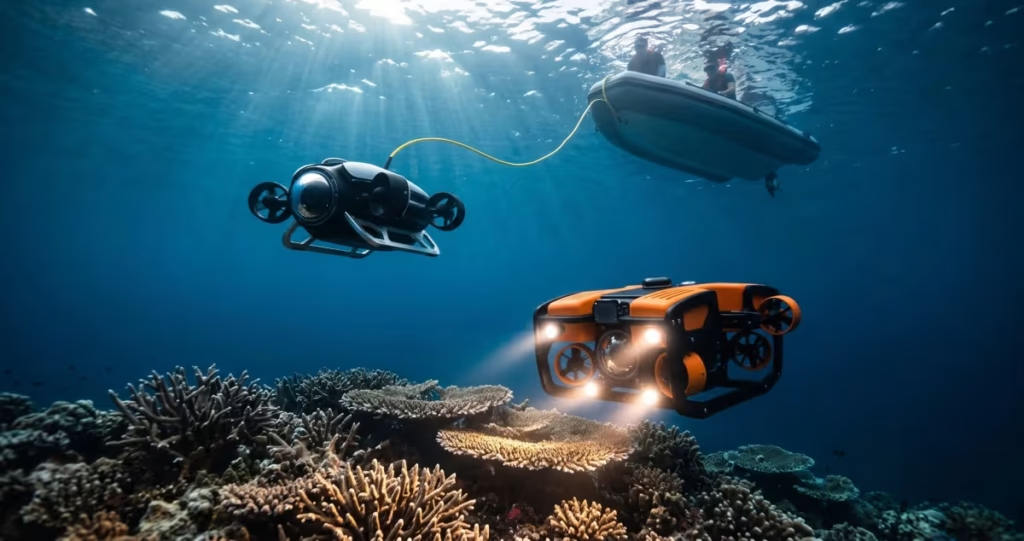
We’ve mapped the moon. We’ve mapped Mars. And yet more than 80% of Earth’s own ocean remains completely unexplored: no photos, no data, nothing. It’s one of the stranger facts about our planet, and it’s exactly why underwater robots have become such a big deal over the past two decades.
Think about it this way: the ocean is dark, freezing in places, crushing at depth, and completely hostile to human bodies past a certain point. Sending someone down there is expensive, risky, and, honestly, impractical for most jobs. So we send robots instead.
Underwater robots are machines built to operate beneath the surface without a person physically down there driving them. Some are tethered to a ship and steered by an operator in real time. Others are left alone entirely, programmed to swim a route, gather data, and surface on their own hours or even months later.
Together, these machines fall under a broader field called marine robotics, and it’s quietly reshaping how we study oceans, maintain offshore infrastructure, and even fight climate change.
This guide walks through what underwater robots actually are, the different types you’ll come across, how they work, and where they’re being put to use right now not in some far-off future, but today.
What Are Underwater Robots, Exactly?
Here’s the simplest way to put it: underwater robots are mechanical devices designed to operate underwater without a human inside or right next to them. Underwater robots are really just one branch of a much wider field, and if you want the basics before going further, it helps to understand what robotics is at its core first.
But “underwater robot” is really an umbrella term. Under that umbrella sits a whole family of machines, some that swim freely on their own, some that stay tied to a boat by a cable, some shaped like torpedoes, and a few, believe it or not, shaped like fish.
What ties them together isn’t their shape or how they move. It’s the job they do: collecting data, inspecting equipment, or exploring places too dangerous, too deep, or too expensive to send a diver.
This is where the term marine robotics comes in; it’s the broader field that covers underwater robots plus the surface vehicles and support systems that work alongside them. Most of these machines are equipped with sensors, cameras, and sometimes robotic arms, allowing them to see, measure, and occasionally even touch the things they’re sent to study.
How Underwater Robots Actually Work
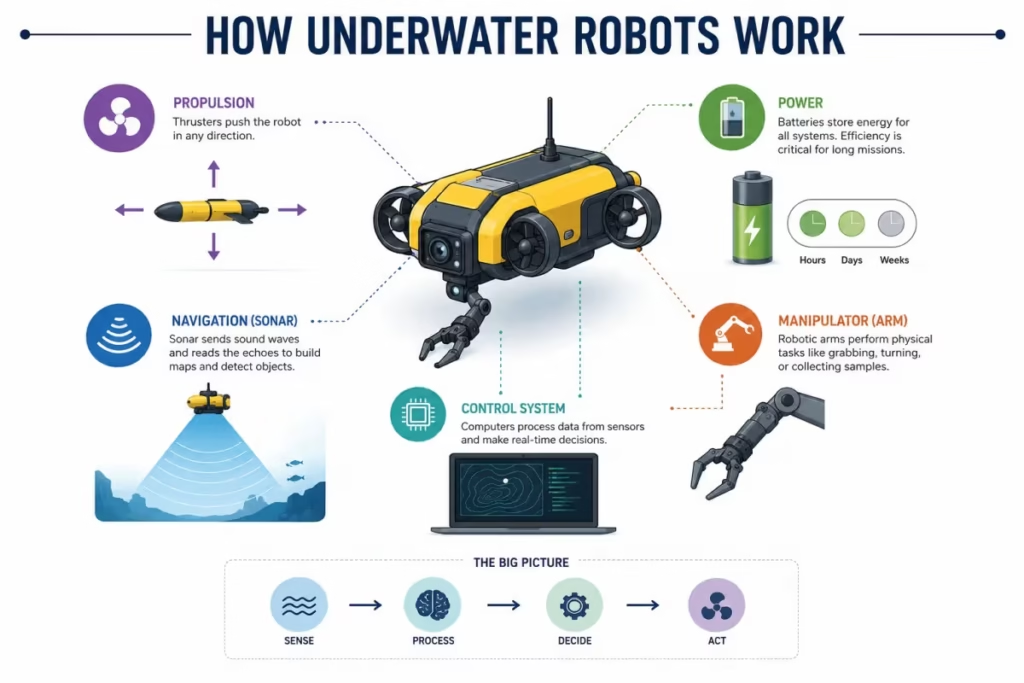
So how does a machine “see” and move around in an environment where sunlight barely reaches, and radio signals basically don’t travel at all? It comes down to a handful of core systems working together.
Propulsion usually comes from thrusters, small, sealed propellers that push the robot forward, backward, up, or down. Some designs, like underwater gliders, skip motors almost entirely and instead shift their buoyancy to sink and rise, riding that motion forward at an angle. It’s slower, sure, but it sips power instead of gulping it, which matters a lot when a mission needs to last for weeks.
Navigation is the trickier part. GPS doesn’t work underwater; signals can’t punch through water the way they do through air. So robots lean on sonar instead, sending out sound waves and reading how they bounce back to build a picture of what’s around them: the seafloor, obstacles, even schools of fish. Some also use inertial navigation, essentially tracking their own movement from a known starting point, the same basic idea a submarine has used for decades.
Power is a constant balancing act. Batteries are heavy, water resists movement, and there’s no plugging in halfway through a dive. This is exactly why energy-efficient designs, like gliders, matter so much for long-duration missions.
And for robots that need to actually do something physical grab an object, turn a valve, take a sample- that’s where a robotic arm, or manipulator, comes in. The same core building blocks propulsion, sensors, power, control- show up whether you’re designing something for the ocean or just figuring out how to build a robot from scratch.
Types of Underwater Robots
Not all underwater robots are built the same. It’s a bit like the different types of robots in agriculture, where a robot picking fruit looks nothing like one monitoring soil moisture; the job shapes the design.
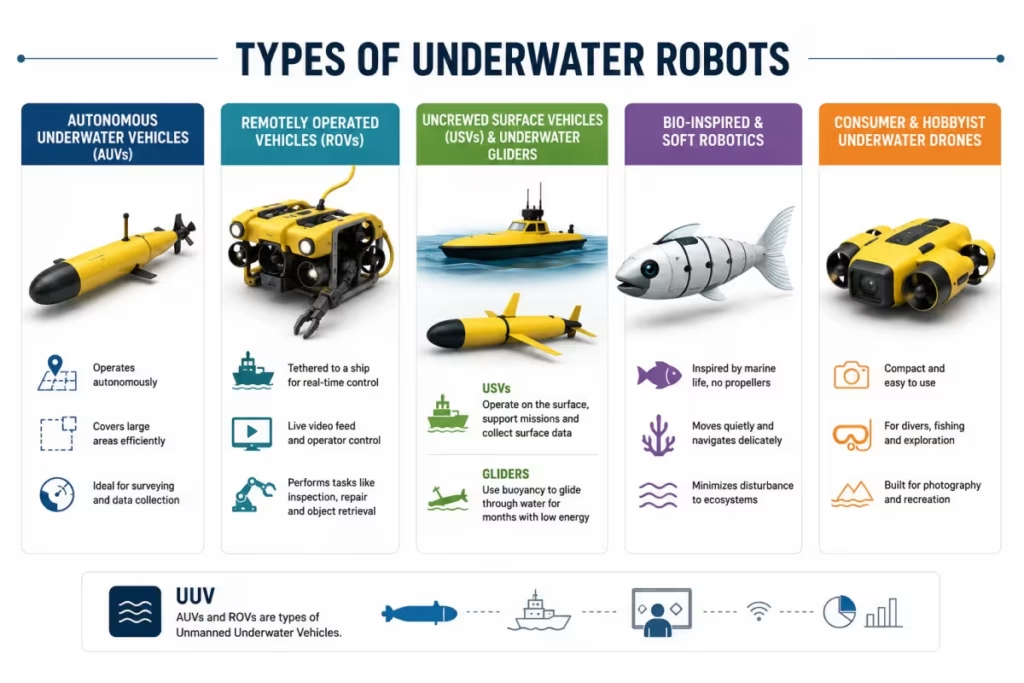
A robot inspecting an oil pipeline needs completely different capabilities than one mapping the deep seafloor for months at a time. Let’s break down the main categories you’ll actually run into.
Autonomous Underwater Vehicles (AUVs)
AUVs are the independent operators of the underwater robot world. Once they’re programmed and dropped in the water, they follow their mission on their own. That independence isn’t unique to the ocean, either; it’s the same idea behind autonomous mobile robots in agriculture, which roam fields on their own without anyone at the wheel, with various sensors, and are built for one thing above all: covering large areas efficiently.
That independence comes with a trade-off, though. Since there’s no live video feed and no manipulator arm on most AUVs, they’re better suited to surveying and data collection than hands-on tasks like repairs. Think of them as the research scientists of the underwater robot family, quietly gathering information, then coming back to report what they found.
Remotely Operated Vehicles
Unlike AUVs, these stay connected to a ship through a tether a cable that carries power, video, and control signals back and forth in real time. An operator sits above the surface, watching a live feed and steering the vehicle as it works.
That constant connection means these robots can do things AUVs can’t: turn valves, cut lines, retrieve objects, and respond instantly if something unexpected shows up on camera.
That’s why they’re the go-to choice for offshore infrastructure inspection and repair work, where a human needs to make real-time judgment calls even if they’re not physically in the water.
Uncrewed Surface Vehicles and Underwater Gliders
Not every marine robot goes below the surface. Uncrewed surface vehicles, or USVs, operate on the water’s surface, often supporting AUVs and other underwater robots or collecting their own surface-level data.
Underwater gliders, meanwhile, sit in an interesting middle ground. Rather than relying on propellers, they shift small amounts of buoyancy to sink and glide forward, then rise again on a slow, saw-tooth path through the water that uses very little energy.
That efficiency is exactly why gliders can stay out on missions for months, something battery-hungry AUVs simply can’t match. Both AUVs and ROVs fall under a broader technical term, unmanned underwater vehicle (UUV), which is just the umbrella category covering any underwater robot without a person on board.
Bio-Inspired and Soft Robotics
This is where things get genuinely fascinating. Some researchers have moved away from propellers entirely. Soft robotics isn’t unique to the ocean, either; that same flexible, gentle-touch engineering shows up in robotics in healthcare, from surgical tools to soft prosthetics.
Soft, flexible robotic fish use flapping tail fins instead of thrusters, letting them slip through tight coral crevices or approach marine life without scaring it off the way a noisy propeller would.
It’s not just a neat trick, either; this approach genuinely solves a problem. Traditional propeller-driven robots can disturb delicate ecosystems or get tangled in vegetation. A soft, fish-shaped robot can study a reef without the reef even noticing it’s there.
Consumer and Hobbyist Underwater Drones
Not every underwater robot belongs to a research institute or an oil company. In recent years, compact underwater drones have become available to divers, fishing enthusiasts, and hobbyists smaller, camera-equipped devices designed for exploration and photography rather than industrial work.
They’re a scaled-down cousin of the AUV and ROV world, built for accessibility rather than heavy-duty performance.
AUV vs ROV: Key Differences
If there’s one question that comes up more than any other in underwater robotics, it’s this one: what’s actually the difference between an AUV and an ROV? They both look similar from the outside: torpedo-shaped, sensor-covered, built to survive serious pressure. But how they’re controlled changes everything about what job they’re suited for.
| AUV | ROV | |
|---|---|---|
| Control | Pre-programmed, fully autonomous | Tethered, controlled live by an operator |
| Connection to surface | None | Physical cable (tether) |
| Best for | Large-area surveys, mapping, long-duration data collection | Inspection, repair, tasks needing real-time judgment |
| Manipulator arm | Rarely | Usually |
| Depth limitation | Generally deeper-capable, no tether drag | Limited by tether length |
| Cost to operate | Lower, no support crew needed during the mission | Higher, needs a vessel, operator, and tether system |
The honest way to think about it: AUVs are built for coverage, ROVs are built for control. If a mission needs a robot to quietly survey hundreds of square kilometers of seafloor over a month, an AUV wins easily.
If a mission needs a robot to turn a specific valve on an offshore pipeline right now, while someone watches the video feed and makes the call, that’s ROV territory. Neither one is “better”; they’re just built for different problems, which is exactly why most serious marine robotics operations end up using both.
Real-World Applications of Marine & Underwater Robotics
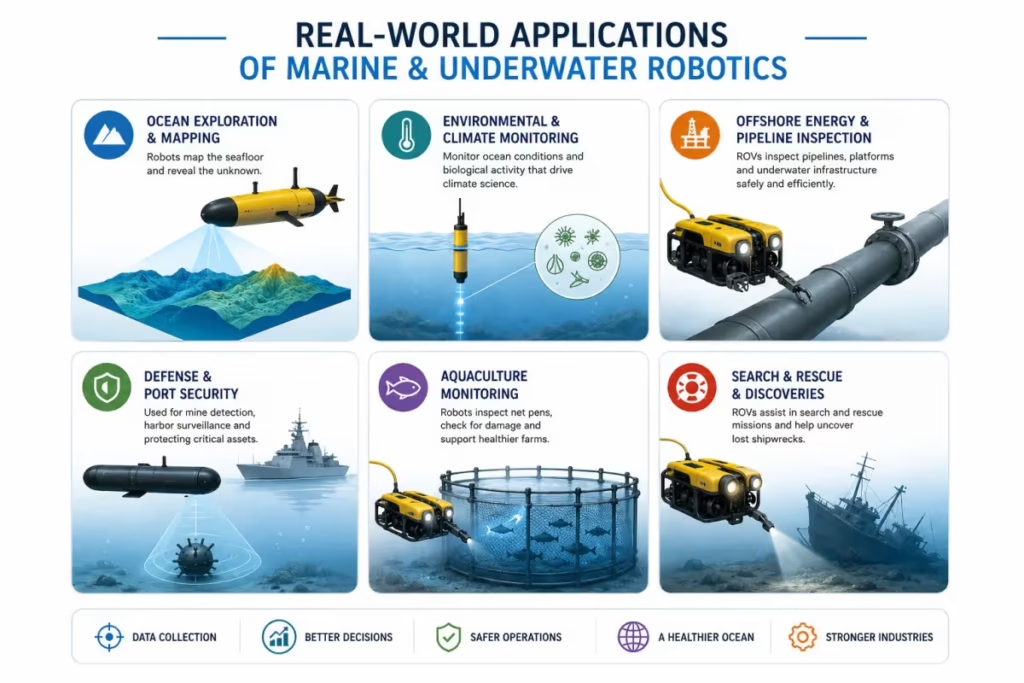
This is where all that engineering actually earns its keep. Underwater robots aren’t just research curiosities anymore; they’re doing real, practical work across a surprising number of industries.
Ocean exploration and mapping is the most obvious one. Robots are helping fill in that massive 80% gap in ocean mapping we mentioned earlier, quietly building a picture of the seafloor one mission at a time.
Environmental and climate monitoring has become one of the fastest-growing uses. AUVs and autonomous floats now track ocean temperature, salinity, and even biological activity like phytoplankton blooms data that feeds directly into climate science.
We covered a great real-world example of this in our piece on autonomous ocean robots discovering phytoplankton shifts off Canada’s coast, where BGC-Argo floats are quietly collecting biogeochemical data across entire ocean basins without a single research vessel needed on-site.
Offshore energy and pipeline inspection rely heavily on ROVs. Oil and gas companies use them to check pipelines, platforms, and underwater cables for damage jobs that used to require sending divers into genuinely dangerous conditions.
Defense and port security are another major application, with robots used for mine detection, harbor surveillance, and inspecting ship hulls for anything that shouldn’t be there.
Aquaculture fish farming, basically, increasingly uses underwater robots to monitor net pens and check for damage. It’s essentially the underwater cousin of precision agricultural robotics and autonomous farming, applying that same sensor-driven, close-monitoring approach to water instead of soil.
And then there’s search and rescue, where ROVs have played a role in some of history’s most famous underwater discoveries, including locating shipwrecks that would’ve been nearly impossible to find any other way.
Challenges in Underwater Robotics
For all their capability, underwater robots operate in one of the most unforgiving environments on the planet, and that creates real, persistent challenges.
Pressure and corrosion are the obvious ones. The deeper a robot goes, the more crushing force it has to withstand, which means every housing and seal has to be engineered with zero room for error. Add saltwater into the mix, and corrosion becomes a constant threat to anything metal, electrical, or moving.
Communication is arguably the trickiest problem of all. Radio waves that work perfectly fine in the air basically die within a few meters of entering water.
That’s why underwater robots lean so heavily on sonar instead of anything resembling Wi-Fi, and it’s also why AUVs are typically left to run missions on their own rather than being remotely piloted the way a drone in the sky might be. There’s just no reliable way to stream live control signals to something hundreds of meters underwater.
Power and endurance round out the big three. Batteries are heavy, water resistance eats energy fast, and there’s no roadside charging station down there. It’s the reason gliders exist at all: trading speed for the kind of energy efficiency that keeps a mission alive for months instead of hours.
The Future of Marine & Underwater Robotics
AI-driven autonomy is probably the biggest one. Robots are getting better at making decisions mid-mission instead of just following a fixed pre-programmed path, adjusting course when they spot something interesting, or avoiding an obstacle without waiting for human input.
Swarm robotics is another area gaining real momentum: instead of sending one expensive AUV to survey an area, researchers are experimenting with fleets of smaller, cheaper robots working together, covering more ground in less time.
And global mapping efforts, like the push to fully chart the world’s seafloor by the end of the decade, are accelerating demand for exactly this kind of technology. Combine that with continued progress in soft robotics and energy-efficient designs, and it’s fair to say marine robotics is still very much in its early chapters, not its final form.
Wrapping Up
Underwater robots have quietly become one of the most important tools we have for understanding our own planet, which, ocean-wise, we still barely know. Whether it’s an AUV mapping the seafloor, an ROV fixing a pipeline, or a soft robotic fish slipping through a coral reef without disturbing a thing, these machines are doing work that would be dangerous, slow, or flat-out impossible for humans alone. And as the technology keeps improving, that 80% unexplored figure isn’t going to stay that big for much longer.
1. What’s the difference between an AUV and an ROV?
An AUV runs on its own: no cable, no live operator, just a pre-programmed mission it carries out independently. An ROV stays tethered to a ship the whole time, with a person actively steering it and watching a live video feed. Simply put: AUVs survey on their own; ROVs get driven.
2. How deep can underwater robots go?
It depends on the design, but the deepest ones can reach the bottom of the Mariana Trench, over 10,900 meters down, deeper than any human diver could ever survive unaided. At that depth, water pressure is genuinely staggering: NOAA notes that around 6,000 meters, the pressure is equivalent to an elephant sitting on a single quarter. Most working AUVs and ROVs, though, operate in a far more modest range, often a few hundred to a couple thousand meters, depending on the job.
3. Are underwater drones the same thing as underwater robots?
Pretty much, yes. “Underwater drone” is just a more casual, consumer-facing name for the same basic idea. The term usually shows up around compact, camera-equipped models built for divers, fishermen, and hobbyists rather than heavy industrial or research work. Still, technically they fall under the same underwater robot umbrella as AUVs and ROVs.
4. How do underwater robots communicate without Wi-Fi?
They can’t use Wi-Fi at all, really; radio waves die within a few meters of hitting water. Instead, most underwater robots rely on sonar and acoustic signals, which travel through water far better than radio ever could. It’s slower and carries less data, but it’s the only reliable option once a robot is more than a few meters below the surface.
5. What is the most famous underwater robot in history?
That’d likely be the team behind the 1985 discovery of the Titanic wreck. A towed camera sled named Argo helped locate the wreck, and the following year, a small remotely operated vehicle called Jason Jr. was sent in to photograph the ship’s interior, a moment that’s still considered one of the biggest milestones in underwater robotics history.
6. Are underwater robots only used for research and defense?
Not anymore. While research and defense were the original driving forces, today’s underwater robots show up in offshore energy inspection, aquaculture, port security, environmental monitoring, and even hobbyist diving and photography. The technology has quietly spread into a lot more industries than most people realize.