
You’ve probably seen the video of a humanoid robot doing a backflip in a lab, sticking the landing cleaner than most gymnasts. Or maybe it was a tiny wheeled machine quietly vacuuming your friend’s living room while everyone ignored it. Either way, something clicked. What exactly is going on inside that thing?

That curiosity is exactly where robotics starts. And honestly, it’s a bigger field than most people realize. We’re not just talking about factory arms and sci-fi androids. Robotics today covers machines that perform surgery, harvest strawberries, deliver medications through hospital hallways, and keep elderly people company when no one else is around.
The numbers back up just how fast this is moving: 542,000 industrial robots were installed worldwide in 2024 alone, more than double the figure from a decade ago, according to the International Federation of Robotics. The total number of robots currently operating in factories globally has surpassed 4.66 million and continues to climb.
What Is Robotics?
Robotics is the branch of science and engineering focused on designing, building, programming, and operating robots. That definition sounds simple enough, but it covers an enormous amount of ground, from a car assembly arm welding door panels in Detroit to a soft robotic exosuit helping a stroke patient relearn how to walk.
What makes robotics unique as a field is how many disciplines it pulls together. You need mechanical engineering to design a body that can actually move. You need electrical engineering to power it and wire its components.
You need computer science to program its behavior. And increasingly, you need artificial intelligence to give it the ability to adapt. Pull any one of those out, and you don’t have a robot; you have a very expensive paperweight.
Here’s a distinction worth making early on, because it trips people up: robotics is not the same as automation. Automation is the broader idea of making processes run without human involvement. Think of a conveyor belt or a thermostat.
Robotics is a specific type of automation where a physical machine perceives its environment, processes that information, and takes action in the real world. The robot is doing something. Automation, in its simplest form, is just following a fixed script.
What Is a Robot?
A useful working definition, one that most researchers agree on, goes like this: a robot is a programmable machine capable of sensing its environment, making decisions based on that input, and performing physical actions in the real world. Three things: sense, decide, act. That’s the loop every robot runs, whether it’s a $2 million surgical system or a $30 Arduino kit on a student’s desk.
The Roomba is actually a perfect example to start with, because everyone either owns one or has seen one bumbling around a friend’s apartment. It uses sensors to detect furniture and stairs, carries out simple computations to figure out whether a patch of floor needs a second pass, and then vacuums. Sense. Decide. Act. Repeat. It’s not glamorous. But it is, by definition, a robot.
What separates today’s robots from earlier machines is the degree of autonomy, or how much they can figure out on their own. A robot arm on an assembly line follows the same preprogrammed path ten thousand times a day without deviation.
A modern surgical robot interprets a surgeon’s hand movements in real time and translates them into micro-precise instrument control. An autonomous farm robot reads sensor data, detects a weed, and decides to zap it with a laser without anyone telling it to. Same category, wildly different levels of independence.
A Brief History of Robotics
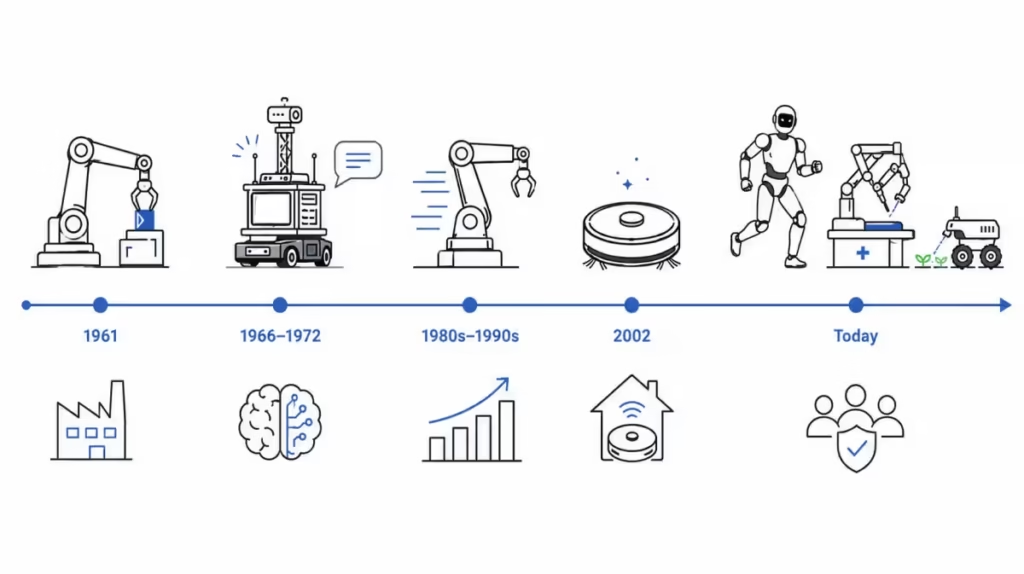
The word itself, as mentioned earlier, came from a 1920 Czech play. But the actual engineering story starts properly in 1961, when a mechanical arm called Unimate rolled onto the floor of a General Motors plant in New Jersey.
Built by George Devol and commercialized by engineer Joseph Engelberger, often called the “father of robotics,” Unimate’s job was straightforward: pick up scorching hot metal pieces from a die-casting machine and stack them, over and over, without complaint. Nobody wanted that job. The robot took it without hesitation.
That same decade, something more ambitious was quietly taking shape at Stanford Research Institute. From 1966 to 1972, a team of researchers built Shakey, the first mobile robot capable of actually reasoning about its environment. Shakey wasn’t just following a set of instructions.
It could perceive a room, make a plan, adapt when things went wrong, and communicate in basic English. Life magazine called it the “first electronic person” in 1970. It was clunky, slow, and looked like a rolling trash can bristling with wires. But the architecture it introduced, sense, plan, act, is still the foundation of almost every autonomous robot built today.
Then came the decades of refinement. Industrial robots became faster, cheaper, and more precise throughout the 1980s and 1990s. And in 2002, something unexpected happened: robots went mainstream. The Roomba, a $200 disc-shaped vacuum cleaner from iRobot, is sold by the millions. For the first time, an ordinary household had a robot in it, not because it was impressive, but because it was genuinely useful. That distinction matters more than people realize.
Today’s landscape is something else entirely. Boston Dynamics’ Atlas performs backflips. Surgical robots operate with sub-millimeter precision. Agricultural robots laser-weed entire fields overnight. Isaac Asimov famously proposed his Three Laws of Robotics in 1950, the first being that a robot may not harm a human, as a thought experiment about machine ethics. Seventy-five years later, those ethical questions aren’t hypothetical anymore.
How Does a Robot Work? The Core Components
Here’s the thing that surprises most people: every robot in the world, regardless of what it looks like or what it does, is built from essentially the same five building blocks. A surgical robot and a robotic lawnmower have almost nothing in common on the surface. Underneath, they’re running the same basic architecture.
| Component | What it does | Human equivalent |
|---|---|---|
| Sensors | Gathers information from the environment | Eyes, ears, skin |
| Control system | Processes data and decides what to do | Brain |
| Actuators | Converts signals into physical movement | Muscles |
| Power supply | Provides energy to run everything | Food and metabolism |
| End effector | The tool that directly interacts with the world | Hands and fingers |
Sensors
Sensors are how a robot understands what’s happening around it. Different robots use different types depending on their job. Cameras give robots sight. Ultrasonic sensors measure distance by bouncing sound waves off objects, the same principle as a bat navigating in the dark. LiDAR fires laser pulses to build a precise 3D map of the surroundings. Touch sensors detect contact. Temperature sensors read heat. A robot without sensors isn’t really a robot; it’s just a machine following a fixed script with no awareness of whether anything went right or wrong.
Control System
This is the brain. A control system, typically a microcontroller or onboard computer, receives the sensor data, runs it through programmed logic or AI models, and decides what to do next. On a simple DIY robot, this might be an Arduino the size of a credit card. On an autonomous vehicle, it’s a stack of powerful computers processing millions of data points per second. The quality of the control system is usually what separates a robot that’s genuinely useful from one that only works in ideal conditions.
Actuators
Actuators are what make a robot actually move. They convert electrical signals into physical action: spinning wheels, rotating joints, extending arms. The most common types are electric motors, which cover most applications, though some robots use hydraulic actuators for heavy-duty force (Boston Dynamics’ earlier Atlas models used hydraulics, for instance) and pneumatic actuators for lighter, faster movements. Actuators are, in a very real sense, the robot’s muscles.
Power Supply
Every robot needs energy. Most smaller and mid-sized robots run on lithium-ion battery packs, the same basic chemistry as in your phone, just scaled up. Larger industrial robots are usually wired directly to the electrical grid since they run continuously and need more power than any battery pack can efficiently store. Solar-powered robots are an increasingly interesting category, too. FarmDroid’s agricultural seeding robot, for example, runs entirely on solar panels and operates around the clock.
End Effector
The end effector is the part of the robot that physically interacts with whatever it’s working on. It’s sometimes called the “hand,” though it rarely looks like one. An industrial welding robot’s end effector is a welding torch. A surgical robot is a set of precision instruments smaller than a fingertip. A pick-and-place warehouse robot uses a vacuum gripper. The end effector is almost always task-specific, which is partly why robots tend to be specialists rather than generalists, at least for now.
Types of Robots
“Medical robot” and “industrial robot” are both robots, but they have about as much in common as a scalpel and a sledgehammer. The word “robot” is really an umbrella covering a surprisingly wide family of machines. Understanding the main types makes the whole field click into place much faster.
Industrial Robots
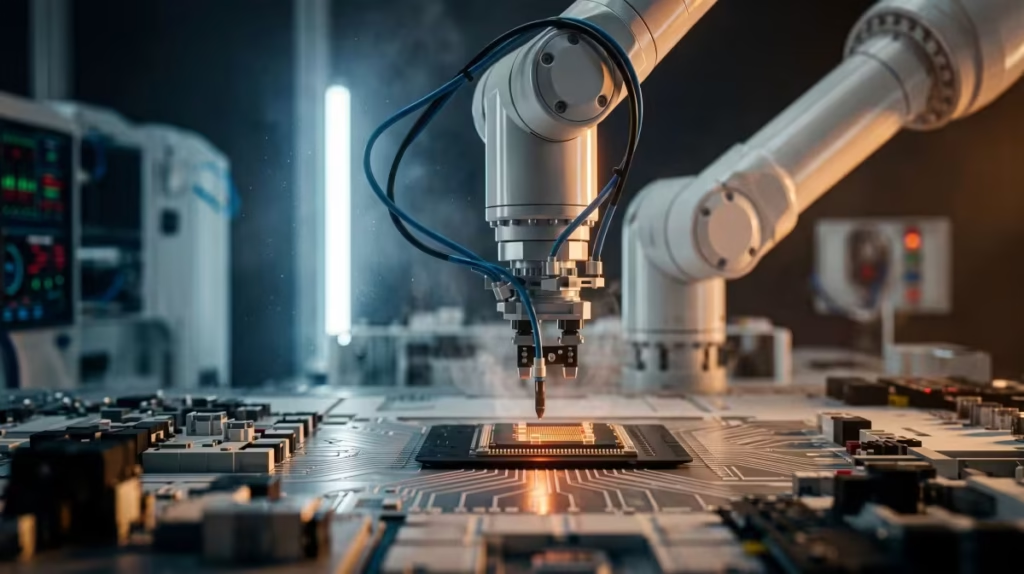
These are the original robots, the ones most people picture when they hear the word. Industrial robots are large, powerful, and precise mechanical arms designed for manufacturing tasks: welding, painting, assembling, packaging, and moving heavy materials.
FANUC, KUKA, and ABB are the biggest names in this space, and their machines are on factory floors everywhere from Toyota plants in Japan to electronics factories in Shenzhen. They don’t look humanoid, they don’t interact with people, and they don’t need to. They just do one thing, or a handful of things, extraordinarily well, over and over.
Collaborative Robots (Cobots)
Cobots are a newer and genuinely interesting twist on the industrial robot idea. Unlike traditional factory arms that work behind safety cages too dangerous to be near, cobots are specifically designed to share a workspace with humans. They’re lighter, slower, and equipped with sensors that make them stop the moment they detect unexpected contact.
Universal Robots’ UR series is probably the most widely deployed cobot family in the world right now. A cobot can hand a component to a human worker, assist with a task that requires both machine precision and human judgment, and then step aside. That kind of fluid human-robot cooperation was almost impossible twenty years ago.
Autonomous Mobile Robots (AMRs)
AMRs navigate real-world environments independently with no fixed tracks and no pre-painted lines on the floor. They perceive their surroundings, plan routes, avoid obstacles, and adapt on the fly. You’ll find them in Amazon’s warehouses, moving shelving units to human pickers.
You’ll find the hospital version delivering medication trays down corridors. And you’ll find agricultural versions — like those discussed in our guide to autonomous mobile robots in agriculture, navigating farm fields at night, weeding and seeding without a single person watching.
Humanoid Robots
These are the ones that fuel the imagination and, honestly, divide opinion. Humanoid robots are built to resemble and move like people: two legs, two arms, a head. Boston Dynamics’ Atlas can run, jump, and perform backflips with unnerving grace.
Figure’s humanoid robot has started commercial deployments in BMW manufacturing facilities. Whether humanoid robots will become genuinely practical workhorses or stay closer to research demonstrations is still very much an open question, but the pace of progress has accelerated sharply since large AI models started powering their decision-making.
Service and Domestic Robots
This is the category that’s already in people’s homes, whether they think of it that way or not. The Roomba. The robotic lawnmower. The pool-cleaning robot. Service robots handle specific, often repetitive tasks in everyday environments. On the commercial side, this category includes the TUG robot in hospitals, the Xenex LightStrike disinfection robot, and cleaning robots increasingly found in airports and shopping centers.
Agricultural Robots

A category that doesn’t always make the “types of robots” lists but probably should, given how fast it’s growing. Robots that weed, seed, harvest, and monitor crop health are now commercially deployed on farms across Europe, the US, and Asia. This entire category gets its own deep treatment in our full breakdown of types of robots used in modern farming because it deserves far more than a single paragraph.
Where Are Robots Used Today?
Manufacturing is still the largest and most roboticized sector by a significant margin. South Korea leads the world with 1,220 industrial robots per 10,000 manufacturing workers, according to IFR’s 2026 report, more than seven times the global average of 162.
In the most automated factories on the planet, there’s roughly one robot for every eight human workers. The electronics and automotive industries together account for the largest share of deployments globally, though food processing and metal fabrication have seen some of the fastest recent growth.
Healthcare is where robotics has arguably had its most personal impact. Surgical robots like the da Vinci system perform complex minimally invasive procedures through incisions smaller than a fingertip. Rehabilitation exoskeletons help stroke patients relearn how to walk. Disinfection robots blast hospital rooms with UV light between patients. If you want the full picture of how each of these works and what it costs, our guide to robotics in healthcare covers every category in depth.
Disinfection robots blast hospital rooms with UV light between patients. Companion robots sit with elderly people living alone and alert caregivers when something seems off. The medical robots market grew by 91% in unit sales in 2024 alone, the fastest growth rate of any robotics category tracked by the IFR.
Agriculture is undergoing its own quiet revolution, one most people haven’t noticed because it happens in fields rather than factories. Autonomous weeding robots, seeding robots, spraying drones, and robotic milking systems are increasingly standard equipment on modern farms — read how precision agricultural robotics is changing autonomous farming for the economics and real-world numbers behind it.
Logistics and warehousing were transformed by Amazon’s acquisition of Kiva Systems in 2012. What was once a curiosity is now standard infrastructure: fleets of AMRs moving goods through distribution centers faster and more accurately than any human-staffed system could. The transportation and logistics segment was the largest category of professional service robots sold in 2024, with over 102,900 units shipped.
Space exploration remains one of robotics’ most dramatic applications. NASA’s Perseverance rover has been collecting rock samples on Mars since 2021, operating with a communication delay of up to 24 minutes each way, meaning every decision it makes, it makes alone. That’s about as autonomous as a robot gets.
Disaster response and search and rescue round out the picture. Robots that can enter collapsed buildings, navigate radioactive environments, and locate survivors in situations too dangerous for human responders have been deployed at disasters from Fukushima to earthquake zones. They don’t replace human rescuers, but they go first into places no person should have to.
Getting Started: How to Build Your First Robot
Here’s something most robotics guides won’t tell you upfront: building your first robot is less about engineering genius and more about making a decision. Pick something simple. Start smaller than you think you should. And expect it not to work on the first try because it won’t, and that’s completely fine.
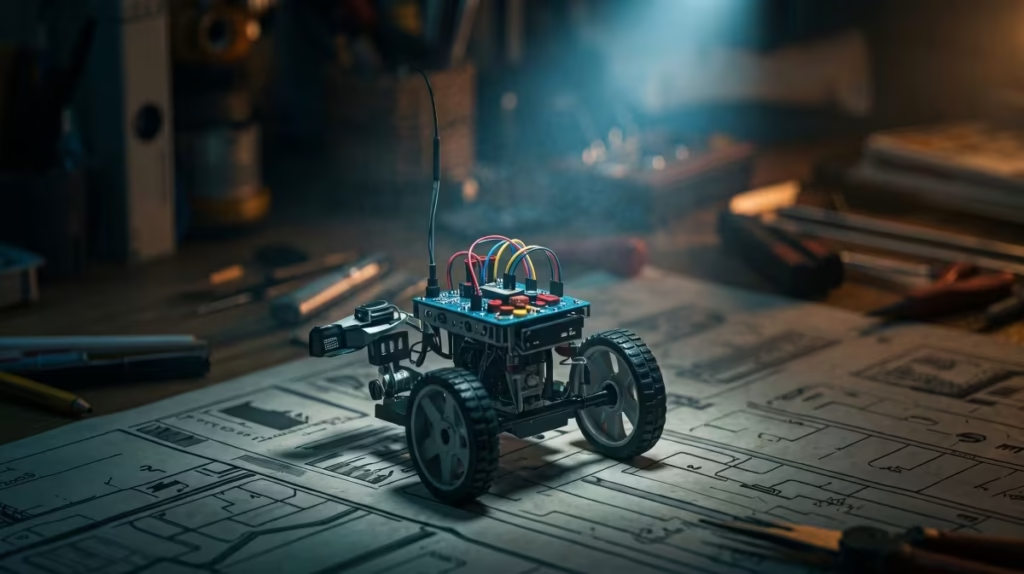
The barrier to entry has dropped dramatically over the last decade. You no longer need a lab, a materials budget, or a computer science degree. A student today can pick up an Arduino Uno starter kit for around $65, follow freely available tutorials from the Arduino community, and have a basic obstacle-avoiding robot moving across their desk within a weekend.
The two most common starting points are worth understanding properly, because people mix them up constantly. An Arduino is a microcontroller, a simple, single-purpose board that runs one program at a time and is designed for direct hardware control. It’s ideal for beginners because it keeps things straightforward: connect a motor, write a few lines of code, see the motor spin. A Raspberry Pi, on the other hand, is a full mini-computer running Linux.
It’s more powerful and better suited for tasks that need camera vision, AI processing, or complex software, but it has a steeper learning curve for someone just starting. The broad rule of thumb: if you want to build something that moves and responds to sensors, start with Arduino. If you want your robot to see and think, a Raspberry Pi setup makes more sense as a second step.
For complete beginners, a pre-assembled robot kit is often the smartest first move. The Elegoo Smart Car, the SunFounder PiCar-X, and the official Arduino Starter Kit are all solid entry points; they come with components, wiring, step-by-step instructions, and active online communities to help when something goes wrong. Prices range from roughly $65 to $150 depending on capability. LEGO’s Mindstorms-era kits remain brilliant for younger builders, though the SPIKE Prime series has largely replaced them in educational settings.
This article gives you the foundation. A dedicated beginner’s guide to building a robot step-by-step, components, wiring, programming, and first project ideas is coming as its own full piece on UrviumRobotics. For now, the most important step is simply picking a direction and starting. Every roboticist you’ve ever admired built something terrible first.
The Future of Robotics
If the past decade was about proving robots could do specific jobs reliably, the next decade feels like something different: robots getting genuinely smarter and showing up in places that weren’t on anyone’s roadmap ten years ago.
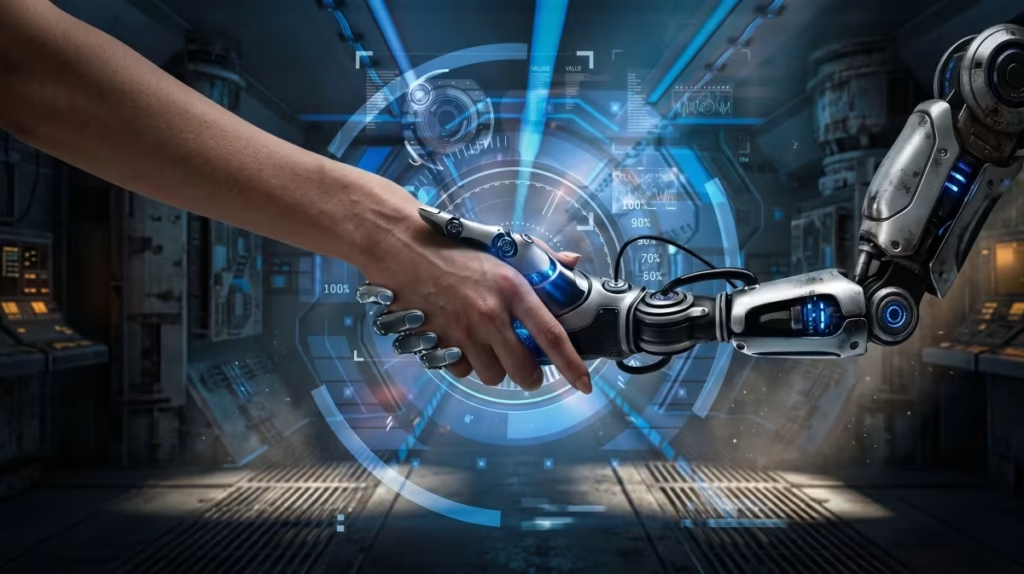
The clearest shift is AI becoming the engine inside the machine, not just a feature bolt-on. The International Federation of Robotics identifies agentic AI systems that combine structured decision-making with adaptive generative intelligence as the defining trend for 2026 and beyond.
In practical terms, that means robots that don’t just execute a program but respond to novel situations, learn from experience, and operate with increasing independence. A surgical robot that flags a risk in real time. A farm robot that decides, mid-field, that conditions have changed and it should switch tasks. An industrial cobot that adapts its movement pattern after watching a human colleague work.
Humanoid robots are moving from research curiosity to early commercial deployment faster than most people expected. Figure’s humanoid robots are already on BMW assembly lines. Tesla’s Optimus is in factory trials. These aren’t finished products, yet they’re early-stage deployments that are generating real-world data far faster than lab conditions ever could. The pace of iteration is striking.
Soft robotics is another thread worth watching. Instead of rigid metal and hard plastic, soft robots are made from flexible, pliable materials that can squeeze through tight spaces, handle delicate objects without crushing them, and move more like biological creatures than traditional machines. The soft robotics market is projected to grow from around $2 billion in 2025 to $8.8 billion by 2030, and healthcare and agriculture are driving most of that growth.
As Demis Hassabis, CEO of Google DeepMind, has put it: “AI will be one of the most transformative technologies in human history.” Robotics is arguably where that transformation becomes most visible, not in a data center, not on a screen, but in the physical world, doing things that used to require a person.
Final Thoughts
Robotics is one of those fields that sounds intimidating from the outside and turns out to be deeply approachable the moment you start actually looking at it. It’s not one thing; it’s a whole spectrum, from a vibrating cup of popsicle sticks that counts as a robot by definition, to a humanoid machine doing backflips in a Boston Dynamics lab. Both are real. Both matter in their own way.
What ties it all together is the loop: sense, decide, act. Every robot in the world, from the simplest hobbyist build to the most sophisticated surgical system, is running that same basic cycle. Understanding that makes the whole field feel less like science fiction and more like engineering, which is exactly what it is.
The global robotics industry has already crossed 4.66 million industrial robots in active operation, with nearly 20 million consumer robots sold in 2024 alone. That’s not a future trend. That’s the world we’re already living in. And if any of this sparked a curiosity to understand it more deeply, whether you’re a student, a hobbyist, or just someone who watched a robot dog and thought “wait, how?” that curiosity is exactly the right place to start.
1. What is the difference between robotics and artificial intelligence?
They’re related but not the same thing. Robotics is about building and operating physical machines that interact with the real world. Artificial intelligence is about making systems, machines, or software capable of learning, reasoning, and making decisions. The two overlap when a robot uses AI to make smarter choices, like a warehouse bot that learns better routes over time. But a robot can exist without AI (a basic factory arm following a fixed program), and AI can exist without a robot (a chatbot running on a server has no physical body at all).
2. What programming language is used in robotics?
It depends on what the robot needs to do. Python is the most beginner-friendly and widely used for robotics programming, especially for tasks involving AI, computer vision, and sensor processing. C++ is preferred when speed and low-level hardware control matter; it’s faster and more precise, which is important in real-time systems. Many beginners start with Arduino’s simplified C-based language before moving to Python. The Robot Operating System, known as ROS, supports both and has become a standard framework across research and industry.
3. What is the difference between a robot and automation?
Automation is the broader concept of any system that performs a task without human involvement. A conveyor belt, a thermostat, and a scheduled email are all automation. A robot is a specific type of automation where a physical machine perceives its environment, processes that information, and takes action in the real world. All robots involve automation, but not all automation involves robots. The key difference is physical presence and adaptability: robots sense and respond; basic automation just executes.
4. Is robotics a good career?
By most measures, yes. The global robotics market is projected to keep growing well into the 2030s, and demand for robotics engineers, programmers, and technicians is rising across manufacturing, healthcare, agriculture, and logistics. The field rewards people who are comfortable crossing disciplines; mechanical engineering, software, electronics, and increasingly AI all come into play. It’s not the easiest career path, but it’s one of the more future-proof ones given where automation is heading.
5. What is the easiest robot to build for a beginner?
A simple obstacle-avoiding robot is the classic first project; it needs just a microcontroller like an Arduino, a couple of ultrasonic sensors, two DC motors, a chassis, and a battery pack. Total cost can be under $30 for a DIY build, or around $65–$100 for a kit that includes everything pre-selected. Line-following robots are another popular starting point. Both projects teach the core sense-decide-act loop in a tangible, hands-on way without requiring advanced electronics knowledge.
6. How long does it take to learn robotics?
There’s no single answer, but a useful frame: most beginners can build and program a basic functional robot within a few weekends using a starter kit. Getting comfortable enough to design and build something from scratch takes months of consistent practice. Becoming a professional robotics engineer, someone who works on commercial systems, typically involves a degree in engineering or computer science plus hands-on project experience. The encouraging part is that the entry point has never been lower, and the learning curve is genuinely rewarding once you get past the first working prototype.