
Walk into an operating room today, and you might catch a surgeon sitting a few feet away from the patient, hands resting on a console, eyes fixed on a screen. No scalpel in sight. Instead, a robotic arm is doing the cutting, guided by every small movement of the surgeon’s fingers. It sounds like something out of a sci-fi film. But it’s just another Tuesday in modern medicine.

Here’s the thing: robotics in healthcare isn’t some far-off concept anymore. It’s already here, and it’s growing fast. Global sales of medical robots reached approximately 6,100 units in 2023, marking a 36% increase compared to the previous year. That’s not a small bump. That’s a quiet revolution happening inside hospitals, clinics, and even people’s living rooms.
And the money backing this shift tells its own story. The global medical robots market, valued at roughly $13.8 billion in 2023, climbed to about $16 billion in 2024 and is projected to grow at a yearly rate of over 16% through 2029, eventually pushing past the $30 billion mark. Physician and author Dr. Ronald Razmi put it plainly when he noted that robotics-assisted procedures can lead to a 21% reduction in hospital length of stay. That’s real time, real money, and real relief for patients who’d rather be home than in a hospital bed.
What Is Robotics in Healthcare?
Robotics in healthcare is exactly what it sounds like: the use of robots and robotic systems to help with medical tasks. That covers a lot of ground, honestly. It could mean a robotic arm assisting a surgeon during a complex operation, or it could mean a small wheeled robot rolling down a hospital hallway, dropping off medication trays so a nurse doesn’t have to.
The idea isn’t new, though it might feel that way given how often it shows up in the news lately. Medical robots first entered the picture in the 1980s, when robotic arms started lending a hand, quite literally, during surgical procedures. Back then, it was clunky, experimental, and honestly a bit nerve-wracking for anyone watching closely. Fast forward a few decades, and the technology has matured into something far more refined, thanks largely to advances in artificial intelligence, computer vision, and sensor technology.
Now, here’s a distinction worth making early on, because people mix this up constantly: robotics in healthcare is not the same thing as robotic process automation (RPA) in healthcare. RPA refers to software bots that handle paperwork-style tasks, things like processing insurance claims or updating patient records in the background. What we’re talking about here is physical robotics: machines with arms, wheels, or wearable frames that interact with the real, physical world of patient care. Different tools, different jobs, though both fall under that bigger “automation in healthcare” umbrella.
What makes today’s medical robots genuinely different from their earlier versions is autonomy and precision. Some robots still need a human hand guiding every move, like the surgical systems mentioned earlier. Others operate with far more independence, navigating hospital corridors on their own, avoiding obstacles, taking elevators, and showing up exactly where they’re needed. As one healthcare physician, Bob Wachter, described the broader shift happening across medicine, this moment represents nothing short of the greatest experiment in the history of medicine, and robotics is very much part of that experiment.
It’s worth sitting with that for a second. We’re not just talking about convenience here. We’re talking about machines that can hold a scalpel steadier than the most experienced human hand, or remind a lonely senior to take their medication when no one else is around to do it. That’s the real promise of robotics in healthcare: not replacing the people who care for us, but giving them sharper tools and a little more breathing room, actually, to focus on the human part of the job.
Types of Medical Robots
Now here’s where things get genuinely interesting. “…as a racecar has with a delivery van. Same general category, completely different job. (Farming has the same problem as a weeding robot and a milking robot share almost nothing except the word “robot.”) Let’s go through the main types, one by one.”Same general category, completely different job. Let’s go through the main types, one by one.
Surgical Robots
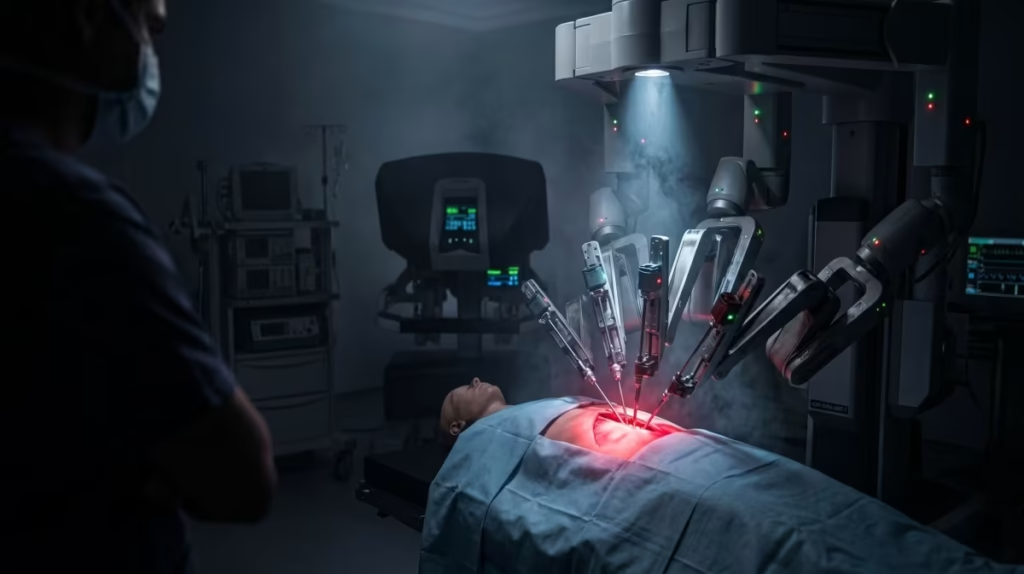
This is the one most people picture first, and for good reason. Surgical robots, like the well-known da Vinci system, let surgeons perform complex operations through tiny incisions instead of large open cuts. The surgeon sits at a console nearby, controlling robotic arms that move with a steadiness no human hand can quite match, no tremors, no fatigue after six hours of a long procedure.
The appeal here goes beyond just looking impressive on a hospital brochure. Minimally invasive surgery generally means smaller scars, less blood loss, and a faster bounce-back for the patient. Hospitals like Johns Hopkins have leaned heavily into this technology, citing improvements in precision and recovery time as a major draw for both surgeons and patients.
Rehabilitation Robots and Exoskeletons
Think of these as a personal trainer that never gets tired and never loses patience because, well, it’s a machine. Rehabilitation robots and wearable exoskeletons help patients recovering from strokes, spinal injuries, or major surgeries regain movement through repetitive, carefully measured exercises.
What’s neat is how these systems have started pairing up with AI to read a patient’s progress in real time and adjust accordingly. A robot might notice a stroke patient is struggling slightly more on their left side this week and tweak the resistance or repetition count on the fly. Researchers behind one pilot study, in fact, built a system that communicates with stroke survivors through a headset detecting neural activity, letting the robot interpret what movement a patient intends and respond with verbal encouragement and visual demonstration. That’s not just rehab; that’s rehab that listens.
Telepresence and Telemedicine Robots
These are the robots that let a doctor “be” in two places at once, in a manner of speaking. A telepresence robot is essentially a screen on wheels, letting a specialist consult with a patient from hundreds of miles away, navigating hospital corridors and rolling right into a patient’s room as if they’d walked in themselves.
This became especially valuable during the pandemic years, when in-person visits carried real risk. One well-known example, the RP-VITA system developed by iRobot and InTouch Health, allowed physicians to conduct remote consultations while navigating hospital hallways independently, no human chaperone required. For rural communities or anyone living far from a specialist, this kind of access can be the difference between getting timely care and waiting weeks for an appointment.
Hospital Logistics and Service Robots

Not every medical robot touches a patient directly, and that’s perfectly fine; some of the most useful ones work quietly behind the scenes. Autonomous mobile robots, often shortened to AMRs, handle the unglamorous but essential work of moving supplies, medications, and lab samples around a hospital. It’s the same core technology, RTK GPS, LiDAR, and real-time obstacle avoidance that’s quietly changing how AMRs navigate farm fields, just trading dirt for hospital tile. Picture a small robot gliding down a corridor, taking the elevator on its own, and dropping off a tray of medication at the right nurses’ station, freeing up staff to spend that time actually talking to patients instead of running errands.
Robotic dispensing systems fall into this category, too, and the safety numbers here are honestly striking. One study evaluating a robotic medication dispensing system found that the total rate of dispensing errors dropped from 0.204% to 0.044% after the system was introduced, and the rate of errors that actually reached a patient fell from 0.015% to 0.002%. That’s not a minor improvement. That’s the kind of safety net that quietly prevents real harm.
Disinfection Robots
You know that uneasy feeling of wondering just how clean a hospital room really is? Disinfection robots exist to make that worry a little less necessary. These robots use intense pulsed UV light to destroy bacteria, viruses, and fungi on surfaces- no chemicals, no residue, just light doing the heavy lifting.
Xenex’s LightStrike robot is probably the best-known name here, and it’s backed by some genuinely strong numbers. A study conducted by Netcare Hospitals in South Africa found the robot to be 99.6% effective at deactivating Candida auris, a particularly stubborn and dangerous fungus. Hospitals using the system have reported steep drops in infection rates, too. Facilities have credited LightStrike for helping decrease MRSA, C.diff, and surgical site infection rates by more than 50, 70, and 100 percent, respectively. A single disinfection cycle typically runs just a few minutes, which means a robot can realistically clean dozens of rooms in a single day without ever getting tired or cutting corners.
Social and Companion Robots
And then there’s the type of medical robot that doesn’t perform surgery or clean a single surface; it just keeps someone company. Social robots like PARO, a robotic therapeutic seal, or ElliQ, a companion device designed for older adults living alone, focus purely on emotional and mental well-being. They chat, they remind, they notice when something seems off.
It might sound like a small thing compared to robotic surgery, but for an elderly person living alone, a daily check-in from a companion robot can genuinely matter, sometimes catching a missed medication or a subtle change in mood before it becomes something bigger. Healthcare isn’t only about treating illness, after all. Sometimes it’s just about making sure nobody falls through the cracks.
Examples of Robots in Healthcare Today
Reading about robot categories is one thing. Seeing actual robots, with actual names and actual price tags, makes the whole picture click a lot faster. So here’s a look at some of the real machines currently working inside hospitals and homes right now, not hypothetical future tech, but stuff that’s already on the floor, doing the job.
| Robot | Type | What It Does | Real-World Use | Approximate Cost |
|---|---|---|---|---|
| da Vinci Surgical System | Surgical | Assists minimally invasive surgery via robotic arms controlled by a surgeon | Used in gynecology, urology, cardiac, and general surgery worldwide | $1.5–2.5 million upfront, plus $100,000–200,000 yearly maintenance |
| Xenex LightStrike | Disinfection | Uses pulsed UV light to destroy bacteria, viruses, and fungi on surfaces | Deployed in over 1,000 hospitals, including Mayo Clinic and MD Anderson | Typically leased or purchased on a per-unit hospital contract |
| RP-VITA | Telepresence | Let physicians remotely consult with patients while navigating hospital halls | Used for remote stroke consultations and specialist check-ins | Enterprise hospital licensing is not sold individually to consumers |
| TUG | Hospital logistics | Autonomously delivers medications, meals, and supplies through hospital corridors | Common in large hospital systems for freeing up nursing time | Hospital-wide fleet leasing model |
| ReWalk / EksoNR | Rehabilitation exoskeleton | Wearable robotic frame that supports walking and movement therapy | Used in stroke and spinal cord injury rehab centers | Tens of thousands of dollars per unit, often covered partially by insurance for eligible patients |
| ElliQ | Social/companion | AI-driven companion device for older adults living independently | Used in home-care settings to provide reminders and check-ins | Subscription-based, typically a few hundred dollars a month |
A few things jump out here. First, the price range is enormous, from a multi-million-dollar surgical system down to a monthly subscription for a companion device. That’s the nature of this field; “medical robot” covers everything from operating-room hardware to something that sits on a kitchen counter. Second, notice how many of these aren’t sold outright to hospitals anymore. Leasing and subscription models have become common, mostly because a $2 million upfront cost is simply out of reach for a lot of smaller hospitals, especially in regions where healthcare budgets are already stretched thin.
It’s also worth pointing out that the da Vinci system, despite being the most recognizable name in this space, isn’t cheap to run even after the initial purchase. One real-world cost analysis across 14 US hospitals and roughly 6,000 da Vinci cases found a weighted average variable cost of around $8,025 per case, on top of fixed costs. That’s a number hospital administrators think about constantly because every robotic procedure has to justify its price tag through better outcomes, not just impressive technology.
How Robotics Improves Patient Care
Alright, let’s get to the part that actually matters most: what does any of this mean for the person on the receiving end? Because honestly, none of this technology means much if it doesn’t translate into better, safer, more comfortable care for real patients.
Precision and Better Surgical Outcomes

Human hands are remarkable, but they shake. They tire. They have limits that a robotic arm simply doesn’t deal with. That steadiness translates into something measurable. One cohort study of over 1,000 patients found that robotic-assisted colorectal surgery was independently associated with a significantly lower rate of complications compared to open surgery, along with a reduced inflammatory response after the operation. That inflammatory response detail matters more than it sounds; a calmer immune response after surgery generally means a smoother, less painful recovery.
It’s not a clean sweep across every single procedure, to be fair. A review pooling data from over 5,500 patients found robotic platforms were linked to a lower overall complication rate compared with laparoscopic surgery, though operative time tended to run longer with robotic techniques, and several specific complications showed no real difference between the two approaches. So robotics doesn’t automatically mean superior in every measurable way, but the trend, especially around complications and length of stay, leans favorably toward robotics in a fair number of procedures.
Faster Recovery, Lower Infection Risk
This is the one that patients actually feel in their daily lives. Smaller incisions generally mean less trauma to the body, which means less pain, less blood loss, and a quicker return to normal activity. Dr. Ronald Razmi has pointed to robotics-assisted procedures cutting hospital length of stay by around 21%, which, if you’ve ever sat in a hospital bed counting ceiling tiles, you’ll know is no small thing.
Infection control tells a similar story, just from a different angle. Remember the disinfection robots from earlier? Hospitals using Xenex’s LightStrike system have reported MRSA, C.diff, and surgical site infection rates dropping by more than 50%, 70%, and even 100% in some cases. Combine that with robotic surgery’s smaller incisions, and you start to see a pattern: robotics is chipping away at infection risk from multiple angles at once, not just one.
More Consistent Rehabilitation and Therapy
Here’s something that doesn’t get talked about enough: recovery isn’t just about the surgery itself. It’s about everything that happens after the weeks and months of physical therapy that determines whether someone actually gets their life back. And human therapists, as skilled as they are, can’t give every single patient an hour of perfectly calibrated, endlessly patient repetition every single day. There just aren’t enough hours or enough therapists to go around.
Rehabilitation robots fill that gap. They don’t replace a physical therapist’s judgment, but they do offer something a therapist physically can’t: unlimited patience and pinpoint consistency, session after session. A stroke survivor working with an AI-paired rehab robot gets real-time feedback on exactly how their movement is improving, week over week, with adjustments made on the fly rather than guesswork. That kind of granular tracking used to be nearly impossible outside a research lab.
Expanded Access via Telepresence and Home Care

And then there’s the access piece, which honestly might be the most quietly important benefit of all. Not everyone lives near a major hospital. Not everyone can drive three hours to see a specialist, especially not right after a stroke or a major diagnosis. Telepresence robots close that gap in a way that feels almost obvious once you see it in action: a neurologist consulting on a stroke case from across the state, appearing on a screen mounted on a robot that’s already standing at the patient’s bedside.
Home care robots extend that same idea even further, right into someone’s living room. An elderly person living alone, with a companion robot quietly checking in daily, isn’t just less lonely, though that matters plenty on its own. They’re also more likely to get noticed if something’s wrong before it turns into an emergency room visit. Dr. Baligh Yehia of Jefferson Health put it well when discussing technology’s role in care: a lot of what doctors and nurses do requires a real human touch, the kind you can’t get through a machine, but that doesn’t mean machines can’t be the early-warning system that gets a human there faster.
Put it all together, and the throughline becomes pretty clear. Robotics in healthcare isn’t really about flashy machines doing flashy things. It’s about shaving days off hospital stays, catching infections before they spread, giving tired therapists a tireless assistant, and reaching patients who’d otherwise be left waiting. That’s the kind of progress that’s easy to overlook until you, or someone you love, actually needs it.
Challenges and Disadvantages of Robotics in Healthcare
The Cost Problem Is Real
Remember that $1.5 to $2.5 million price tag on a single da Vinci system? That’s just the entry fee. Add in $100,000 to $200,000 a year in maintenance, plus staff training that can run into the tens of thousands more, and you start to understand why plenty of hospitals, especially smaller ones or those in lower-income regions, simply can’t get in the game. A single da Vinci system can cost over $2 million, not including annual service costs, which remains a major barrier for many healthcare facilities.
This creates a kind of two-tier system, whether anyone intends it or not. Big city hospitals with deep pockets get the latest robotic tech. Rural clinics and underfunded public hospitals often don’t. And that gap in access can end up mattering just as much as the technology itself because a brilliant surgical robot sitting in one hospital across the country doesn’t help a patient who can’t get there.
Training and Integration Take Time
Here’s something easy to overlook: a robot is only as good as the person operating it. Surgeons need real, supervised hours learning a new system before they’re truly proficient, and that learning curve isn’t instant. Hospitals also need to rework workflows, train support staff, and figure out how a new robotic system fits alongside everything else already happening on a busy hospital floor. None of that happens overnight, and none of it is free.
Safety, Malfunctions, and Liability
This is the part nobody likes discussing, but it matters too much to skip. Robots, like any machine, can fail. A peer-reviewed study analyzing FDA adverse event reports from 2000 to 2013 found that device and instrument malfunctions made up the majority of reported incidents involving robotic surgical systems, including problems like broken instrument pieces falling into patients, electrical arcing, and unintended instrument operation. In about 10.4% of all reported events, the procedure had to be interrupted entirely either to restart the system, switch to a non-robotic technique, or reschedule the surgery altogether.
To be clear, this is older data covering the earlier years of robotic surgery adoption, and the technology has matured a great deal since then; newer systems come with more built-in safety checks and redundancies. But it’s a fair reminder that “robotic” doesn’t automatically mean “risk-free.” When something does go wrong mid-surgery, the question of who’s responsible, the manufacturer, the hospital, or the surgeon, gets complicated fast, and that liability puzzle is still being sorted out in courtrooms even today.
The Human Connection Question

And then there’s the part that doesn’t show up in any cost spreadsheet or malfunction report: the emotional side of care. Dr. Baligh Yehia said it best: a lot of healthcare is “high touch,” requiring real empathy, like literally holding someone’s hand when they’re scared. A robot, however advanced, can’t replicate that. It can remind a patient to take medication. It can’t comfort a frightened family member at 2 a.m.
There’s also a quieter worry simmering under the surface: what happens to the human workforce as robots take over more tasks? Most experts seem to agree that robots are meant to support clinicians, not replace them, freeing up time for the human parts of the job. But that reassurance only holds up if hospitals actually use the time saved for more patient interaction, rather than just running leaner staffing models. That’s less a flaw in the robots themselves and more a question of how honestly hospitals choose to use them.
Robotics in Healthcare Beyond the Hospital
Here’s something that surprises a lot of people: not all medical robots live in hospitals. Some of the most meaningful work happening in this space is taking place in ordinary homes, far away from any operating room or ICU.
Companion Robots for Aging in Place
Picture an elderly woman living alone, miles from her nearest family member. Roughly 28% of seniors today live alone, and that number isn’t shrinking; a Harvard University study projects that the number of single-senior households will double by 2038. That’s a lot of people facing many quiet days with little company.
This is exactly the gap companion robots like ElliQ were built to fill. And the early results are honestly pretty striking. A rollout by the New York State Office for the Aging found that ElliQ led to a 95% reduction in loneliness among participating seniors. A separate company-reported study found similarly strong numbers, with 80% of users reporting reduced loneliness, 82% reporting better mental health, and 90% saying they simply felt better overall after using the robot. Now, it’s worth noting that researchers studying ElliQ have been upfront that larger, independent clinical trials are still needed to fully confirm these effects over the long run. But even with that caveat, the direction of the data is hard to ignore.
What’s neat about ElliQ specifically is what it doesn’t try to be. Dor Skuler, the company’s CEO, has said the goal was never to replace human connection; they wanted users to form a relationship with ElliQ as ElliQ, not as a stand-in for a person. It nudges someone to take a walk, plays their favorite music, suggests a stress-relief exercise, and, maybe most usefully, it can alert a caregiver if it notices the person hasn’t slept well or seems unwell. That’s not flashy robotics. That’s just someone’s grandmother getting noticed a little faster when something’s off.
Remote Rehabilitation, Right at Home
The same exoskeletons and rehab robots we talked about earlier aren’t strictly confined to hospital rehab wings anymore, either. Lighter, more portable versions are increasingly making their way into home settings, letting patients continue their recovery exercises without driving back and forth to a clinic three times a week. For someone recovering from a stroke, especially in a rural area, that convenience isn’t just nice to have; it can be the deciding factor in whether they actually stick with their rehab program long enough to see real results.
Telehealth Robots Closing the Distance
We touched on telepresence robots inside hospitals earlier, but the same basic idea- a doctor “showing up” remotely- works just as well for home visits. A nurse or specialist checking in on a homebound patient through a robotic device can catch warning signs early, ask follow-up questions, and get a much better sense of how someone’s actually doing day to day, compared to a phone call alone.
So while the surgical robots and disinfection bots tend to grab the headlines, this quieter side of the industry, robots showing up in living rooms instead of operating rooms, might end up touching just as many lives, if not more. Healthcare doesn’t only happen inside a hospital building, and increasingly, neither does robotics.
The Future of Robotics in Healthcare
So, where does all this go from here? If the past two decades were about proving robots could safely assist in a handful of procedures, the next few feel like they’re about something bigger: robots becoming smarter, smaller, and a lot more common, not just in operating rooms but everywhere care happens.

More Competition, Lower Barriers
For years, Intuitive Surgical’s da Vinci system basically had the surgical robotics market to itself. That’s changing fast. Medtronic and CMR Surgical both received FDA clearance for new surgical systems in December 2025, capping a steady wave of regulatory approvals, funding rounds, and clinical trial launches from companies building new minimally invasive surgery platforms. Industry watchers now describe two emerging tiers of competitors: large multinational players like Medtronic and Johnson & Johnson going head-to-head with Intuitive, alongside specialized companies like Shanghai-based MicroPort MedBot and Japan’s Medicaroid, carving out their own niches.
Why does that matter for an ordinary patient? More competition usually means prices come down over time, and that $2 million price tag that’s kept smaller hospitals on the sidelines might not stay quite so untouchable. It’s not an overnight fix, but it’s a meaningful crack in a market that’s been pretty locked up for two decades.
AI Is Becoming the Real Engine
Here’s the bigger shift: honestly, robotics in healthcare is increasingly inseparable from artificial intelligence. The International Federation of Robotics points to agentic AI as a defining trend for 2026, combining analytical AI for structured decision-making with generative AI for adaptability, aiming to make robots capable of working more independently. In medical terms, that could mean a surgical robot that doesn’t just mirror a surgeon’s hand movements, but actively flags a risk it’s noticed in real time, or a rehab robot that adjusts a patient’s therapy plan the moment it detects a setback, not next week’s appointment, but right now.
Physician and author Bob Wachter has called the broader AI-in-medicine moment nothing short of the greatest experiment in the history of medicine, and that framing fits robotics neatly, too. We’re watching machines move from being tools a person operates to something closer to a collaborator that notices, adapts, and occasionally even anticipates.
Smaller, Softer, Stranger Machines
Some of the most exciting research happening right now doesn’t look anything like the bulky robotic arms we picture today. Soft robotics machines built from flexible, pliable materials instead of rigid metal are opening doors that traditional robots couldn’t. The soft robotics market alone is projected to grow from around $2 billion in 2025 to $8.8 billion by 2030, and healthcare is one of the biggest reasons why. Researchers are exploring soft robotic exosuits for rehabilitation and even micro-scale robots tiny enough to navigate inside the human body, delivering targeted treatment exactly where it’s needed instead of flooding the whole system.
A Market That Isn’t Slowing Down
The numbers back up just how seriously the industry is taking this shift. The global medical robotics market grew from roughly $14.9 billion in 2023 to a projected $57 billion by 2032, driven largely by an aging global population and growing demand for minimally invasive care. That’s not a niche corner of medtech anymore. That’s a sector that hospitals, investors, and governments are all watching closely.
Will every prediction here pan out exactly as described? Probably not; emerging tech rarely does. But the direction is pretty unmistakable: more autonomy, more affordability over time, and robots showing up in more corners of patient care than most of us would’ve guessed even five years ago. The question isn’t really whether robotics will keep expanding in healthcare. It’s how thoughtfully the industry manages that growth, making sure access, safety, and that all-important human touch don’t get left behind in the rush.
Final Thoughts
So, where does that leave us? Robotics in healthcare isn’t a single shiny gadget or a passing trend; it’s a sprawling, genuinely useful shift touching nearly every corner of patient care, from the operating table to someone’s living room. Surgical robots are making complex procedures safer and less invasive. Disinfection robots are quietly knocking down infection rates that used to feel almost unavoidable. Companion robots are sitting with lonely seniors who’d otherwise spend their days without a single check-in. None of that is hype. It’s already happening, right now, in hospitals and homes, most of us walk past every day.
And yet, it’s not a flawless story, either. The price tags are steep, the training curve is real, and no robot, however advanced, can hold a frightened patient’s hand the way a nurse can. That tension between what machines can do and what only people can do isn’t going away anytime soon, and honestly, it probably shouldn’t. The goal here was never to replace the human side of medicine. It was to give the people doing that work a little more time, a little more precision, and a little more support.
…robots and doctors, working the same shift, each doing what they do best. It’s a pattern showing up everywhere automation touches people’s lives. Agriculture is going through its own version of the same shift so that patients, at the end of it all, just get better care.
1. Are robots replacing doctors and nurses in healthcare?
No, not really, and that’s a common misunderstanding. Most robots used in healthcare are designed to assist clinicians, not replace them. A surgical robot still needs a surgeon at the controls, and a delivery robot just frees up a nurse’s time so they can spend more of it actually with patients instead of running errands down the hall.
2. Is robotic surgery safer than traditional surgery?
For many procedures, yes, robotic-assisted surgery tends to mean smaller incisions, less blood loss, and a lower risk of certain complications compared to open surgery. That said, it’s not automatically better for every single procedure, and like any medical equipment, robotic systems can occasionally malfunction, so “safer” doesn’t mean “risk-free.”
3. What is the most common robot used in hospitals?
Surgical robots like the da Vinci system tend to get the most attention, but hospital logistics robots, the ones quietly delivering medications and supplies through hallways, are actually some of the most widely deployed, just less talked about.
4. Can a robot perform surgery completely on its own?
Not yet, no. Every robotic surgical system currently in clinical use is operated by a human surgeon at a console. The robot translates the surgeon’s movements with more precision and steadiness, but it isn’t making independent decisions or operating without a person guiding it.
5. Are medical robots covered by insurance?
Coverage depends on the procedure and the insurance provider, not the robot itself. Many robotic-assisted surgeries are covered the same way their traditional equivalents would be, since insurers typically pay for the procedure and outcome rather than the specific tool used to perform it. It’s worth checking directly with your insurer before a planned procedure.
6. How much does a medical robot cost?
It varies wildly depending on the type. A surgical system like the da Vinci can run $1.5 to $2.5 million upfront, plus six figures a year in maintenance. On the other end, a home companion robot like ElliQ is more of a monthly subscription, costing a few hundred dollars rather than millions.